
In industrial lighting applications, thermal conditions are not merely an environmental parameter; they are often the dominant factor that determines whether a lighting system delivers its promised performance or fails prematurely. Unlike commercial or architectural installations, industrial luminaires are frequently deployed in environments where ambient temperatures far exceed the safe operating limits of conventional lighting products. Steel mills, foundries, glass factories, ceramic kilns, industrial ovens, power plants, and heavy manufacturing facilities routinely expose lighting systems to sustained temperatures well above 80°C, with certain zones reaching or exceeding 150°C and, in extreme cases, approaching 200°C.
Although LED technology is widely recognized for its high efficiency and long operational life, these advantages are highly temperature-dependent. Elevated thermal stress accelerates lumen depreciation, destabilizes chromaticity, degrades electronic components, and significantly shortens system lifetime. In such conditions, the question is no longer whether an LED luminaire is efficient, but whether it is thermally resilient.
Thermal resistance has therefore become one of the most critical performance indicators in industrial LED design. A luminaire’s ability to operate reliably at 90°C, 150°C, or 200°C ambient temperature reflects not only the quality of its materials and components, but also the sophistication of its system-level thermal engineering. This article provides a comprehensive technical analysis of thermal resistance in industrial LEDs, explaining how different temperature classes are defined, achieved, and applied, and how they align with real-world industrial operating environments.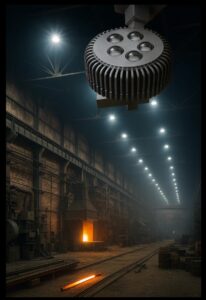
2.1 Heat Generation in High-Power Industrial LEDs
LEDs are often perceived as “cool” light sources because they emit significantly less radiant heat than incandescent, halogen, or HID lamps. However, this perception can be misleading in industrial contexts. High-power LEDs convert only a portion of electrical energy into visible light; the remainder is dissipated as heat at the semiconductor junction. As drive currents increase to achieve high luminous flux, heat generation rises proportionally.
In industrial installations, this internally generated heat is compounded by external sources. Nearby furnaces, kilns, molten materials, heated conveyors, and process equipment radiate large amounts of thermal energy into the surrounding space. As a result, the lighting system must cope not only with its own thermal load, but also with continuous exposure to intense ambient and radiant heat.
2.2 Junction Temperature, Case Temperature, and Ambient Temperature
A clear understanding of temperature terminology is essential when evaluating thermal resistance. Ambient temperature refers to the temperature of the surrounding air in which the luminaire operates. Case temperature is measured at a defined point on the luminaire housing or LED package, while junction temperature represents the actual temperature at the LED semiconductor junction, where light is generated.
Among these parameters, junction temperature is the most critical determinant of LED performance and longevity. As junction temperature increases, luminous efficacy decreases, color characteristics shift, and material degradation accelerates. Even modest increases in junction temperature can result in exponential reductions in useful life. In high-temperature industrial environments, maintaining junction temperature within safe limits becomes increasingly difficult, making thermal resistance a defining design challenge.
2.3 Thermal Runaway and Long-Term Degradation
When heat is not effectively managed or tolerated, LEDs may enter a condition known as thermal runaway. As temperature rises, electrical resistance increases, causing additional heat generation that further elevates temperature. This positive feedback loop can lead to rapid failure.
More commonly, prolonged exposure to elevated temperatures causes gradual but irreversible degradation. Phosphor materials may deteriorate, resulting in lumen loss and color shift. Encapsulants can yellow or crack, solder joints may fatigue due to thermal expansion, and electronic components—particularly electrolytic capacitors in drivers—can fail prematurely. These mechanisms explain why standard LED luminaires often perform well in laboratory tests but fail quickly when installed in real industrial heat zones.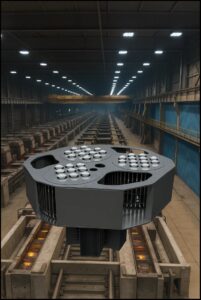
3.1 Defining Thermal Resistance Ratings
A thermal resistance rating specifies the maximum continuous ambient temperature at which an LED luminaire can operate while maintaining acceptable performance, safety, and lifetime characteristics. A 90°C-rated luminaire is designed to operate reliably in environments where the surrounding air temperature reaches up to 90°C, whereas 150°C and 200°C ratings indicate progressively higher levels of thermal endurance.
These ratings are not arbitrary labels. They reflect the cumulative effect of LED chip selection, packaging materials, circuit design, driver architecture, optical components, and mechanical construction. Importantly, a true high-temperature rating implies continuous operation at the stated temperature, not short-term survival or intermittent exposure.
3.2 Testing, Validation, and Safety Margins
High-temperature LED luminaires are typically validated through extended thermal aging tests conducted in controlled chambers, where ambient temperature is maintained at or above the rated level for thousands of hours. Junction temperature is monitored to ensure it remains within safe limits, and performance parameters such as luminous flux, color stability, and electrical integrity are measured over time.
A credible thermal rating also incorporates conservative safety margins. Industrial environments are rarely uniform, and localized hot spots or unexpected process changes can push temperatures beyond nominal values. Robust thermal resistance design accounts for these realities.
3.3 Common Misinterpretations of High-Temperature Capability
One of the most common misconceptions is equating large heat sinks or high wattage ratings with high-temperature capability. In extremely hot environments, the surrounding air may be hotter than the luminaire itself, rendering traditional heat dissipation ineffective. In such cases, thermal resistance depends less on removing heat and more on the ability of materials and components to withstand heat without degradation.
4.1 Typical Operating Conditions
Industrial LEDs rated for 90°C ambient temperature represent the entry level of high-temperature lighting solutions. These products are designed for environments that exceed standard commercial conditions but do not reach extreme industrial heat levels. Typical applications include manufacturing workshops, logistics warehouses with process heat, mechanical rooms, and enclosed luminaires with limited airflow.
4.2 Design Approach and Materials
At the 90°C level, thermal resistance is achieved through enhanced but conventional engineering methods. High-quality aluminum heat sinks, metal-core printed circuit boards, and industrial-grade LED packages are commonly employed. Driver components are selected for extended temperature tolerance, and thermal paths are optimized to minimize junction temperature rise.
The focus at this level is maintaining efficiency and long service life while accommodating moderately elevated ambient temperatures.
4.3 Performance Expectations
When properly designed and installed, 90°C-rated industrial LEDs can deliver stable luminous output and color consistency over extended operating periods. Lumen maintenance remains high, and lifetimes exceeding 50,000 hours are achievable. For many industrial facilities, this thermal class offers an optimal balance between reliability, performance, and cost.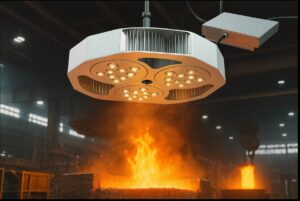
5.1 The Significance of the 150°C Threshold
An ambient temperature of 150°C represents a critical threshold beyond which most conventional electronic components fail rapidly. At this level, plastic materials soften or deform, solder joints experience accelerated fatigue, and standard LED packages exceed safe junction temperature limits. Designing luminaires for continuous operation under such conditions requires a fundamentally different engineering philosophy.
5.2 Advanced Materials and Component Selection
150°C-rated industrial LEDs rely on high-temperature LED chips with reinforced packaging, ceramic or advanced metal substrates, and encapsulation materials specifically formulated for thermal stability. Silicone materials, if used, must be of high-grade formulations capable of maintaining optical clarity and mechanical integrity under prolonged heat exposure.
Electrical wiring, connectors, and seals are selected for high-temperature endurance, and driver circuits are either thermally isolated or engineered using components rated well above standard industrial specifications.
5.3 Operational Stability and Degradation Control
At 150°C, the primary objective shifts from maximizing efficiency to ensuring predictable, controlled performance degradation. A well-engineered system maintains stable light distribution and acceptable color consistency while allowing for gradual lumen depreciation that can be accurately modeled and planned for. This predictability is essential for industrial operators who require reliable illumination for safety and process control.
5.4 Typical Applications
Lighting systems rated for 150°C are commonly deployed in glass manufacturing lines, ceramic firing plants, metal processing facilities, and industrial baking or curing chambers, where sustained high temperatures are an inherent part of the production process.
6.1 Operating at the Edge of Material Limits
An ambient temperature of 200°C pushes lighting technology to the limits of material science. At this level, air ceases to function as an effective cooling medium, and radiant heat dominates the thermal environment. Conventional luminaires, regardless of heat sink size, are incapable of surviving under these conditions.
6.2 Specialized LED and Mechanical Architecture
200°C-rated systems employ highly specialized LED dies, often mounted on ceramic substrates that offer exceptional thermal stability and minimal thermal expansion mismatch. Luminaire housings are typically constructed from metals or alloys selected for structural integrity at extreme temperatures, while optical components are made from glass rather than polymer materials.
6.3 Remote Driver and System-Level Design
One of the defining characteristics of 200°C-rated LED systems is the physical separation of heat-sensitive electronics from the luminaire head. Drivers are relocated to cooler zones outside the high-temperature area and connected via high-temperature-resistant cabling. This architecture significantly improves reliability and simplifies maintenance, making it feasible to operate LED lighting in environments once considered incompatible with solid-state lighting.
6.4 Extreme Industrial Applications
Such systems are used in foundries, smelting plants, kilns, aerospace and military facilities, and specialized research installations where extreme heat is unavoidable and lighting failure is not an option.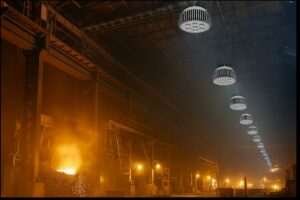
High-temperature industrial LEDs are the result of advances in semiconductor design, materials science, thermal interfaces, and system architecture. High-temperature LED chips with optimized junction structures reduce thermal sensitivity, while ceramic substrates and metal-core boards provide stable mechanical and thermal platforms.
Thermal interface materials used in these systems must remain chemically and mechanically stable over wide temperature ranges, often relying on ceramic-based compounds or mechanical clamping rather than conventional adhesives. Driver isolation strategies further enhance system survivability in extreme environments.
Thermal management focuses on removing heat from a system, typically through conduction, convection, or radiation. Thermal resistance, by contrast, focuses on the ability of a system to continue functioning reliably despite the presence of heat. In environments where ambient temperature exceeds the luminaire’s internal temperature, heat removal is impossible, making thermal resistance the dominant design criterion.
Optical components are often overlooked in discussions of high-temperature performance. However, lenses, reflectors, and protective covers are directly exposed to heat and radiation. Polymer optics may discolor, warp, or crack, leading to beam distortion and light loss. High-temperature LED systems therefore rely on glass optics, metal reflectors, and heat-resistant coatings to maintain optical performance over time.
As operating temperature increases, absolute lifespan typically decreases, but a properly designed system offers predictable performance and maintenance intervals. While 90°C systems may operate for decades with minimal intervention, 150°C and 200°C systems are engineered for survivability and planned maintenance, minimizing unplanned downtime and safety risks.
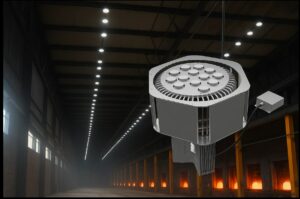
Accurate assessment of ambient temperature, radiant heat sources, duty cycle, and operating hours is essential when selecting a thermal class. Over-specification increases cost without proportional benefit, while under-specification almost guarantees premature failure. Selecting the correct thermal resistance level is therefore a critical engineering and economic decision.
High-temperature industrial LEDs are typically evaluated against international safety and performance standards, supplemented by application-specific testing protocols. Verified test data and transparent documentation are essential for mission-critical installations where lighting reliability directly affects safety and productivity.
Ongoing developments in ceramic LED modules, integrated thermal sensing, smart diagnostics, and Industry 4.0 integration are expanding the capabilities of high-temperature lighting systems. These innovations promise improved reliability, predictive maintenance, and broader adoption in extreme industrial environments.
Thermal resistance is the foundation of reliable industrial LED lighting. Understanding the practical differences between 90°C, 150°C, and 200°C-rated systems enables informed decision-making and ensures that lighting solutions are matched to real operating conditions. As industrial processes continue to evolve and thermal demands increase, high-temperature LED technology will remain a critical enabler of safe, efficient, and reliable illumination.
–The End–