Steel mills and foundries represent some of the most demanding industrial environments for lighting systems. These facilities operate under extreme thermal loads, with ambient temperatures frequently exceeding 60°C and localized hotspots reaching well above 150°C. In such conditions, conventional lighting technologies often fail prematurely, leading to frequent maintenance cycles, operational disruptions, and increased safety risks.
Reliable illumination in these environments is not merely a matter of visibility; it is a critical component of operational safety, precision, and productivity. Workers must be able to clearly monitor molten metal flows, inspect surface finishes, and safely navigate complex machinery layouts. Insufficient or unstable lighting can result in errors, accidents, and costly downtime.
In addition to high temperatures, steel mills and foundries are characterized by heavy airborne particulate matter, including metallic dust, smoke, and slag residues. These contaminants can significantly degrade optical performance and accelerate the aging of lighting fixtures. Furthermore, constant vibration from heavy machinery and exposure to corrosive gases such as sulfur compounds introduce additional stresses on lighting systems.
Therefore, lighting solutions designed for these environments must integrate advanced thermal management, robust mechanical construction, and high-level environmental protection. The transition from traditional lighting systems to high-performance LED solutions has enabled significant improvements in efficiency, durability, and adaptability, making them the preferred choice for modern industrial applications.
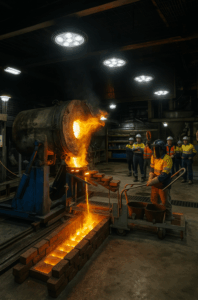
High ambient temperature is the most critical factor affecting lighting performance in steel mills and foundries. In many operational zones, such as near blast furnaces or continuous casting lines, temperatures can consistently remain above 80°C and occasionally exceed 150°C. These conditions severely impact the lifespan of electronic components, particularly LED drivers and semiconductor junctions.
Thermal stress accelerates lumen depreciation, shifts color temperature, and may lead to catastrophic failure if heat is not properly managed. Conventional luminaires, especially those designed for standard industrial environments, typically operate within a maximum ambient temperature range of 40°C to 50°C. Deploying such fixtures in high-temperature zones results in rapid degradation and frequent replacement cycles.
To address this, high-temperature LED lighting systems must be engineered with specialized components, including high-temperature-rated drivers, thermal-resistant wiring, and optimized heat dissipation structures. These systems often incorporate derating strategies and advanced materials to ensure stable performance under sustained thermal exposure.
Steel production processes generate significant amounts of airborne contaminants, including fine metal dust, carbon particles, and combustion byproducts. These particulates can accumulate on luminaire surfaces, reducing light output and causing thermal insulation that exacerbates overheating.
Optical components such as lenses and reflectors are particularly vulnerable. Dust buildup can scatter light, reduce uniformity, and create uneven illumination patterns. Over time, this leads to decreased visibility and increased strain on workers performing precision tasks.
Additionally, particulate ingress into the fixture housing can damage internal electronics and compromise insulation. Therefore, lighting fixtures must be designed with high ingress protection (IP) ratings, typically IP65 or higher, to prevent dust penetration and ensure long-term reliability.
Regular maintenance in such environments is costly and often impractical due to continuous operations. As a result, self-cleaning designs, smooth surface finishes, and anti-static coatings are increasingly incorporated into advanced lighting solutions to mitigate dust accumulation.
Steel mills operate heavy machinery such as rolling mills, presses, and conveyors, all of which generate continuous vibration and occasional mechanical shocks. These dynamic forces can loosen fixture components, damage mounting systems, and degrade electrical connections over time.
Lighting fixtures installed in these environments must be structurally robust, with reinforced housings and secure mounting mechanisms. Vibration-resistant designs often include shock-absorbing materials, reinforced brackets, and locking fasteners to maintain structural integrity.
Moreover, internal components such as LED boards and drivers must be securely fixed to prevent micro-movements that can lead to solder joint fatigue and eventual failure. Testing standards such as IK ratings (impact resistance) and vibration testing protocols are essential to validate the durability of lighting products in such conditions.
Failure to account for mechanical stress can result in intermittent lighting performance, flickering, or complete system failure, all of which pose safety hazards in high-risk industrial settings.
In addition to heat and dust, steel mills and foundries often expose lighting systems to corrosive gases and high humidity levels. Sulfur compounds, oxidation processes, and chemical vapors can attack metal components, leading to corrosion and material degradation.
Standard aluminum housings may suffer from oxidation if not properly treated, while exposed electrical contacts can corrode and increase resistance, resulting in overheating and potential failure. To mitigate these risks, lighting fixtures must utilize corrosion-resistant materials such as anodized aluminum, stainless steel, or specialized coatings.
Sealing technologies also play a crucial role. High-quality gaskets and encapsulation methods are required to prevent moisture ingress, which can cause short circuits and insulation breakdown. In particularly harsh environments, conformal coating of electronic components is often employed to provide an additional layer of protection.
By addressing corrosion and humidity challenges through material selection and protective design, lighting systems can achieve significantly longer operational lifespans and maintain consistent performance in aggressive industrial atmospheres.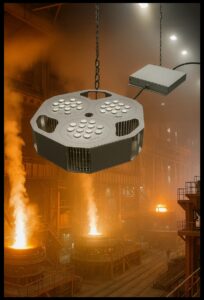
Lighting large industrial facilities requires high luminous output combined with energy efficiency. Steel mills typically feature expansive production floors with high ceilings, necessitating powerful luminaires capable of delivering sufficient illuminance levels, often exceeding 300–500 lux depending on the task.
High luminous efficacy, measured in lumens per watt (lm/W), is essential for minimizing energy consumption while maintaining performance. Modern LED systems achieve efficiencies of 150–180 lm/W, significantly outperforming traditional HID and metal halide lamps.
Efficient lighting not only reduces operational costs but also lowers thermal load, which is particularly important in already high-temperature environments. Additionally, high-efficiency systems contribute to sustainability goals by reducing carbon emissions and energy demand.
Effective thermal management is fundamental to the performance and longevity of lighting systems in steel mills. High-temperature LED fixtures must incorporate advanced heat dissipation mechanisms, including large surface-area heat sinks, high-conductivity materials, and optimized airflow designs.
In extreme cases, active cooling solutions or remote driver configurations may be employed to isolate sensitive components from heat sources. Thermal simulations and real-world testing are critical to ensure that junction temperatures remain within safe operating limits.
Fixtures are often rated for specific ambient temperatures, such as 80°C, 120°C, or even 200°C. Selecting the appropriate rating based on the application environment is crucial to avoid premature failure and ensure reliable operation.
Ingress protection (IP) and impact resistance (IK) ratings are key indicators of a fixture’s ability to withstand harsh environmental conditions. In steel mills, IP65 or higher is typically required to ensure complete protection against dust and water jets.
IK ratings, ranging from IK08 to IK10, indicate resistance to mechanical impacts. High IK ratings are essential in environments where fixtures may be exposed to accidental collisions or falling debris.
These protection standards provide a standardized framework for evaluating product durability and are often specified in procurement requirements for industrial lighting projects.
Continuous operation is a defining characteristic of steel production facilities, making maintenance activities both challenging and costly. Lighting systems must therefore be designed for extended lifespans, typically exceeding 50,000 hours.
Long-life components, combined with robust thermal and environmental protection, significantly reduce the frequency of replacements. This not only lowers maintenance costs but also minimizes operational disruptions.
From a financial perspective, total cost of ownership (TCO) becomes a critical metric. High-quality LED solutions, despite higher initial costs, deliver superior ROI through energy savings, reduced maintenance, and longer service intervals.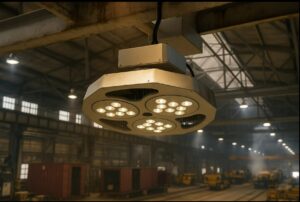
High bay lighting is the backbone of illumination for workshops, production floors, and areas with high ceilings in steel mills and foundries. Unlike conventional HID or fluorescent systems, high-temperature LED high bays are specifically engineered to maintain luminous efficiency and color stability under extreme thermal stress. These fixtures can sustain continuous operation in ambient temperatures ranging from 80°C to 200°C, ensuring uniform lighting even in the proximity of molten metal or furnaces.
Thermal management is achieved through high-conductivity heat sinks, sometimes augmented with forced-air cooling or heat-dissipating alloys. In addition to heat resistance, these fixtures are constructed with robust housings resistant to dust, smoke, and vibration. Optical designs typically include precision reflectors or lenses to deliver uniform light distribution, reducing shadowing and glare—critical for worker safety and precision operations. Modern high bay LEDs can achieve lumen outputs exceeding 50,000 lm, covering large floor areas while minimizing the number of fixtures needed, which reduces maintenance overhead and energy costs.
Casting areas, storage yards, and outdoor operational zones require powerful, wide-angle illumination. High-output LED floodlights designed for industrial use are optimized for both intensity and coverage. These fixtures can achieve lumen outputs above 100,000 lm while maintaining energy efficiencies of 160–180 lm/W, surpassing traditional metal halide or sodium lamps in both performance and durability.
These floodlights are engineered to withstand thermal shock, corrosive atmospheres, and mechanical impact. They often feature modular optics with adjustable beam angles, allowing facility engineers to precisely target areas such as ladle handling zones, molten metal transport routes, and open-air loading yards. Advanced coatings and tempered glass protect against abrasive particulate matter, while vibration-resistant mounting ensures stable operation even in environments with heavy machinery.
The combination of high luminous output, thermal resistance, and environmental protection makes these floodlights ideal for critical outdoor applications where visibility and safety are paramount.
Certain zones in steel mills, particularly areas handling combustible gases, dust, or chemical residues, require explosion-proof lighting solutions. LED explosion-proof fixtures are designed to contain any internal ignition within the housing, preventing external sparks that could trigger catastrophic incidents.
These systems comply with ATEX, IECEx, and UL certification standards, ensuring that they meet rigorous safety regulations. Typically, explosion-proof fixtures integrate high-strength aluminum or stainless steel housings, thick tempered glass, and fully sealed driver compartments. Thermal management is carefully engineered to prevent overheating while maintaining continuous illumination.
In addition to safety compliance, explosion-proof LED fixtures offer superior efficiency, longevity, and optical precision compared to traditional incandescent or HID explosion-proof lamps. They reduce energy consumption and maintenance frequency, crucial for hazardous areas where access is limited and downtime is costly.
Mobile lighting towers provide temporary, high-intensity illumination for maintenance tasks, construction, or emergency operations. These towers are highly versatile, allowing rapid deployment to areas without fixed lighting infrastructure. Typically powered by generators or integrated batteries, mobile towers use high-output LED arrays to achieve uniform lighting across large operational zones.
The fixtures are engineered for high-temperature resistance, vibration tolerance, and environmental protection, matching the standards of fixed industrial lighting. Adjustable mast heights (4–12 meters) and telescopic deployment mechanisms allow engineers to optimize light angles and coverage. Some systems include integrated smart controls for dimming, motion detection, and remote monitoring, enhancing both energy efficiency and operational safety.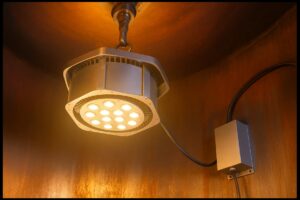
Heat is the primary factor limiting the longevity of LED systems in steel mills. Advanced thermal management technologies include multi-layered heat sinks, thermal interface materials, and high-conductivity alloys that dissipate heat efficiently. Some fixtures integrate forced-air systems or liquid-cooled channels for extreme temperature zones. By maintaining junction temperatures within safe limits, these designs ensure consistent lumen output, prevent color shift, and extend operational lifespan.
LED chips and drivers for industrial environments are specifically rated for high thermal and electrical stress. These components feature reinforced encapsulation, high-temperature solder, and protective coatings to prevent degradation under continuous operation in heat-intensive areas. Driver isolation and surge protection are critical to ensure uninterrupted operation, while specialized circuitry can adapt to voltage fluctuations caused by nearby heavy machinery.
Precision optics enhance worker safety by delivering uniform illumination while minimizing glare and harsh shadows. Lens materials are often heat- and chemical-resistant, maintaining transparency despite dust, smoke, or airborne particulates. Anti-glare diffusers and reflector geometry are optimized to reduce eye strain during long operational shifts, which is particularly important near high-contrast surfaces such as molten metal or reflective steel.
Modern industrial facilities increasingly incorporate smart LED systems with dimming, occupancy sensing, and remote monitoring. IoT-enabled control systems allow facility managers to track energy consumption, schedule maintenance, and adjust light levels dynamically based on operational needs. Integration with factory automation systems enhances efficiency while maintaining safety, and predictive analytics can anticipate fixture failures before they impact production.
Industrial lighting must comply with OSHA requirements in the U.S., as well as IEC and UL certifications. These standards ensure adequate illuminance, color rendering, and emergency preparedness. Compliance ensures that facilities meet legal obligations while promoting worker
ATEX and IECEx certifications are critical for hazardous zones, confirming that lighting systems prevent ignition of flammable atmospheres. Certification processes include rigorous testing for heat, pressure, and mechanical impact under simulated industrial conditions.
Lighting solutions must minimize glare, shadows, and flicker, all of which contribute to accidents and fatigue. Emergency lighting integration is also vital for rapid evacuation, while properly designed illumination ensures operational visibility during night shifts or power interruptions.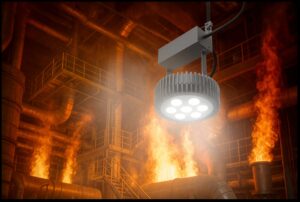
LED technology delivers transformative advantages for steel mills and foundries, where extreme temperatures, dust, and vibration challenge conventional lighting. Energy efficiency is perhaps the most significant benefit: industrial LED systems can reduce power consumption by up to 60% compared to metal halide or high-pressure sodium lamps. This reduction not only decreases operational costs but also mitigates heat accumulation, easing the cooling load in already high-temperature zones.
Longevity and reliability are equally important. High-quality LEDs can operate continuously for over 50,000 hours, far exceeding traditional lighting solutions. Extended operational life reduces maintenance interventions, which are particularly disruptive in facilities operating 24/7. Fewer replacements also mean less exposure of personnel to dangerous environments, enhancing workplace safety.
Optical performance and precision is another key benefit. LEDs maintain consistent color rendering and luminous output even under high heat, dust, and vibration, ensuring accurate visual inspection of molten metals, casting lines, and machinery components. Advanced optics minimize glare and shadows, reducing operator fatigue and improving productivity.
Finally, environmental and sustainability advantages are significant. LEDs eliminate hazardous materials like mercury, reduce carbon emissions due to lower energy use, and enable intelligent lighting controls such as dimming, zoning, and occupancy sensors. These smart capabilities further enhance energy efficiency while supporting sustainability goals. The combination of durability, safety, efficiency, and environmental compliance makes LED technology an indispensable choice for modern steel mills and foundries.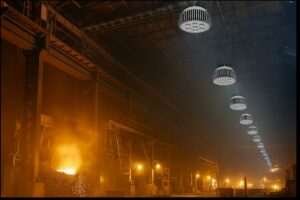
Selecting the appropriate lighting solution for steel mills and foundries requires a methodical evaluation of environmental conditions, operational requirements, and long-term maintenance strategy. The first step is a comprehensive environmental assessment, which considers ambient temperatures, particulate levels, vibration, corrosive gases, and humidity. Each zone may require a different fixture type or protection rating, and understanding these parameters ensures that lighting systems are specified accurately.
Next, lumen output and coverage requirements must be calculated. Factors such as ceiling height, machinery layout, and workspace dimensions determine the number and type of fixtures. High bay LEDs and floodlights should be selected based on lux requirements for specific tasks, with uniform light distribution to avoid shadows and glare. Advanced optical modeling software can simulate illumination patterns to optimize placement.
IP and IK ratings must align with environmental challenges. Dust-prone zones require IP65 or higher, while areas exposed to mechanical impact demand IK08–IK10 protection. Thermal resistance ratings must match the expected temperature profile, with high-temperature drivers and derating strategies incorporated as needed.
Supplier reliability and technical support are also critical. Industrial-grade LED systems require suppliers capable of providing long-term warranties, installation support, and post-sale service. Customization options—such as adjustable beam angles, smart controls, or modular design—should be evaluated for flexibility and future expansion.
Finally, total cost of ownership (TCO) is a central consideration. While upfront costs for industrial-grade LEDs may be higher than traditional lamps, the combination of energy savings, reduced maintenance, and extended service life delivers a superior ROI. A careful, data-driven selection process ensures that lighting investments meet both operational and financial objectives.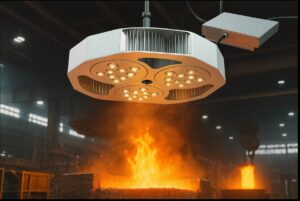
Industrial lighting for steel mills and foundries is evolving rapidly, driven by technological innovation and sustainability priorities. Smart and IoT-enabled systems are becoming mainstream, enabling real-time monitoring of energy consumption, fixture performance, and predictive maintenance. By integrating LED fixtures with sensors and factory automation, managers can adjust lighting dynamically based on operational activity, reducing energy waste while maintaining safety standards.
AI-driven optimization is another emerging trend. Machine learning algorithms can analyze workflow patterns and environmental data to adjust brightness, color temperature, and distribution automatically. This capability not only improves worker comfort but also enhances operational efficiency by aligning illumination with task-specific needs.
Material innovation is also shaping the future. High-efficiency, heat-tolerant, and corrosion-resistant materials are making fixtures lighter, more durable, and easier to maintain. Modular designs allow rapid replacement or upgrades without major downtime, aligning with lean manufacturing principles.
Sustainability continues to influence industrial lighting design. Recyclable materials, lower energy consumption, and environmentally friendly manufacturing processes are increasingly mandated by global standards. Future lighting systems will combine high-performance illumination with minimal environmental impact, supporting both corporate responsibility goals and regulatory compliance.
Overall, industrial lighting is transitioning from a purely functional component to a strategic operational tool, enhancing safety, productivity, and sustainability in steel production environments.
Selecting the right lighting solution for steel mills and foundries is a complex but essential process. High-temperature LED systems provide superior durability, energy efficiency, and safety, transforming operational efficiency in extreme industrial environments. By integrating advanced thermal management, smart controls, and precision optics, industrial operators can achieve consistent illumination while reducing downtime.
–The End—