
In the world of sports, performance is everything—but performance cannot thrive without safety and clarity. Athletes perform at their best when their environment is optimized, and one of the most critical yet often overlooked factors is lighting. Whether on a professional football field, a community basketball court, or a collegiate indoor gym, lighting conditions directly influence both the physical safety of the players and the clarity with which they perceive the game.
Enter LED lighting: a technological breakthrough that has transformed sports venues by offering precision, reliability, and efficiency. Far more than just illumination, LED systems are now a vital component in enhancing player performance, minimizing injuries, and delivering a visually flawless experience for both participants and spectators.
Lighting isn’t just about brightness—it’s about balance, consistency, and eliminating risks. Inadequate or uneven lighting increases the likelihood of accidents. When shadows obscure peripheral vision or sudden brightness shifts throw off depth perception, athletes can misstep, collide, or misjudge objects in motion.
LED lighting addresses these challenges with uniform illumination that eliminates dark spots and reduces glare. High-quality LED systems provide an even distribution of light across the entire playing surface, ensuring that players can move confidently and react instantly.
A study conducted by the Sports Lighting Research Consortium (SLRC) in 2022 found that football stadiums retrofitted with LED lighting saw a 28% reduction in injury reports related to visibility and field conditions. In fast-paced sports like soccer or basketball, where split-second decisions are critical, visibility directly correlates with safety.
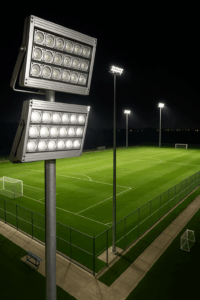
Performance in sports hinges on what athletes see—and how well they see it. From tracking a ball mid-flight to anticipating an opponent’s next move, visual clarity is non-negotiable. This is where Color Rendering Index (CRI) becomes crucial. LEDs with a CRI of 80 or above ensure colors appear vivid and true-to-life under artificial light. This clarity allows athletes to better distinguish jersey colors, line markings, and ball trajectories.
In tennis, for instance, players rely on fine visual cues—spin, speed, bounce angle—to respond effectively. Under low-quality lighting, these details can blur, leading to slower reactions and increased errors. LED systems maintain optimal clarity, even under varying intensities, helping players maintain top form.
Additionally, LED lights support better depth perception, which is essential for sports like baseball or cricket where judging the distance and speed of a fast-moving object is vital. Whether it’s a baseball player tracking a fly ball or a goalkeeper diving to intercept a shot, every movement benefits from accurate, consistent light.
Traditional stadium lighting often relied on wide-beam floodlights that illuminated large areas but lacked precision. LEDs, on the other hand, allow for highly customizable beam angles, enabling lighting designers to direct illumination exactly where it’s needed—and nowhere else.
This precision illumination reduces light spill into non-play areas, enhances visual contrast on the field, and supports strategic lighting zoning. For example, in a multi-use stadium, LEDs can be programmed to emphasize different areas during different events—training, warm-ups, competition, or even post-game interviews.
For sports that require strategic focus areas, like volleyball or wrestling, LEDs can concentrate light on the playing zone while keeping spectator areas moderately lit, creating a dynamic yet focused atmosphere that enhances both gameplay and audience engagement.
Lighting uniformity—how evenly light is distributed across a surface—is a cornerstone of safe and effective sports environments. Inconsistent lighting leads to dark spots and glare, which can compromise safety and disrupt concentration. LED lighting systems boast excellent uniformity ratios, often achieving U1/U2 values greater than 0.8, a significant improvement over legacy lighting systems.
Flicker, particularly imperceptible flicker, is another silent disruptor. It can cause headaches, eye strain, or discomfort for players and viewers, especially in slow-motion broadcast footage. Flicker-free LED lighting, operating at high frequencies, ensures smooth visual experiences for both athletes and spectators—and perfect capture for high-speed cameras.
With the rise of broadcast and livestreamed sports at all levels, LED’s zero flicker capability is now essential. It not only enhances live visibility but also supports post-game analysis and video review sessions, offering players and coaches a clearer view of performance and strategy.
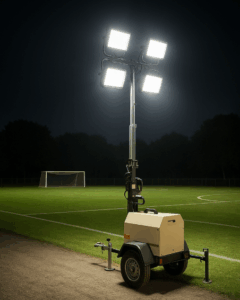
Outdoor sports are subject to unpredictable environmental conditions. Rain, fog, snow, and even humidity can alter how light behaves, affecting visibility. LED lighting systems provide several tools to combat these elements.
First, adaptive optics and lensing allow for tighter control of light dispersion in adverse conditions. Second, LED systems can be tailored in color temperature to suit specific needs—cooler tones (e.g., 5000K–6500K) are ideal for high-contrast visibility during games, while warmer tones are better suited for ambient lighting in foggy or low-light conditions.
Heat is another often-overlooked factor. Traditional lighting systems generate substantial radiant heat, raising on-field temperatures, particularly in indoor settings. LEDs, with their low thermal output, contribute far less heat, keeping the play environment cooler and more comfortable—especially important in indoor arenas and summer tournaments.
Elite performance doesn’t happen by accident—it’s built during practice. Training environments must replicate match-day conditions to prepare athletes effectively. LED lighting allows facilities to simulate game lighting exactly, or even customize light profiles for specific drills.
For example, programmable LED systems can mimic sunrise or sunset conditions for endurance training or simulate opponent-side lighting for psychological preparation. Tunable white and RGB LEDs can also be used to create mood-based lighting for mental conditioning or recovery sessions.
In academies and training camps, where player development is paramount, LED lighting allows for a data-driven approach to lighting management, aligning light intensity and color with circadian rhythms to support energy, alertness, and rest cycles.
Indoor and outdoor sports venues face different lighting challenges, but LEDs offer scalable and adaptable solutions for both. In indoor settings such as basketball gyms, wrestling arenas, or volleyball courts, the primary concern is controlling light reflection and maximizing vertical illuminance.
LEDs excel here with anti-glare coatings and optics designed to reduce ceiling bounce, ensuring clear visibility at every height and angle. This is vital in sports like badminton or volleyball, where the ball or shuttlecock travels high above the court.
For outdoor sports like soccer, baseball, and track & field, the challenge lies in providing consistent lighting across expansive areas with minimal spill into neighboring environments. LED floodlights can be engineered with narrow or asymmetric beam optics, providing intense focus on playing areas without contributing to urban light pollution.
Additionally, LEDs meet the stringent regulations set by international sporting bodies such as FIFA, FIBA, and the NCAA, ensuring compliance for competition and broadcast lighting standards across both settings.
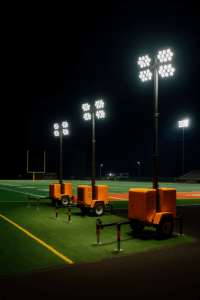
Beyond performance and safety, LED lighting brings robust sustainability and operational benefits. Traditional metal halide or sodium vapor lights suffer from long warm-up times and frequent failures, requiring costly and potentially hazardous maintenance, especially when mounted at high elevations.
LED systems are instant-on, allowing for fast reaction in case of power outage or emergency. This immediate readiness is not only convenient but also essential for evacuation protocols or weather delays. They also last significantly longer—often exceeding 50,000 hours—resulting in fewer replacements and less disruption.
Maintenance is also safer. Fewer climbs, fewer hot components, and fewer replacements reduce the risk to maintenance crews. And because LED systems are typically IP66/IP67 rated, they can withstand dust, rain, and wind with minimal risk of failure.
LEDs contribute to an overall safer, smarter, and more resilient infrastructure, aligning with modern expectations for green construction, energy conservation, and reduced environmental footprint.
Lighting is no longer a passive element of sports infrastructure—it’s an active tool in shaping outcomes. From enhancing visibility and safety to sharpening player performance and supporting sustainable facility management, LED lighting stands at the intersection of technology and athletic excellence.
For facility managers, coaches, and athletes alike, the message is clear: investing in LED lighting is not just about illumination—it’s about empowerment. It’s about enabling the next generation of athletes to train harder, play smarter, and compete safely—under the best light possible.
–The End–