The steel production industry is a cornerstone of modern infrastructure, providing essential materials for construction, transportation, and industrial machinery. Among the most critical processes in steel manufacturing are continuous casting and hot rolling, which involve the transformation of molten steel into semifinished and finished products. These processes operate under extreme conditions, including high temperatures, heavy mechanical vibrations, and exposure to dust, smoke, and metallic particles. In such an environment, the importance of reliable and effective industrial lighting cannot be overstated.
Proper illumination in continuous casting and hot rolling lines ensures operational safety, enhances productivity, and reduces the risk of costly errors. Operators rely on clear visibility to monitor molten steel flows, detect surface defects, and ensure machinery is functioning optimally. Poor lighting can compromise both safety and quality, potentially leading to workplace accidents or product defects. Furthermore, modern steel plants are often expected to run 24/7, meaning that lighting systems must be robust, energy-efficient, and capable of continuous operation with minimal maintenance interruptions.
This article aims to provide a comprehensive guide to reliable lighting solutions for continuous casting and hot rolling lines. It discusses the challenges inherent to these environments, outlines essential lighting requirements, evaluates suitable technologies, and provides design considerations. By examining real-world applications and best practices, this article will serve as a reference for engineers, facility managers, and decision-makers seeking to optimize industrial lighting in demanding steel production environments.
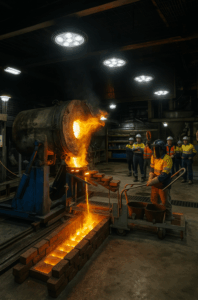
Lighting in steel production environments is uniquely challenging due to several compounding factors. The first major challenge is the harsh environmental conditions inherent to continuous casting and hot rolling operations. In continuous casting areas, temperatures can reach upwards of 1,500°C, generating intense radiant heat and exposing lighting fixtures to thermal stress. Hot rolling lines, while slightly cooler, still present elevated temperatures and constant heat radiation from steel slabs. Dust, smoke, and metallic fumes are prevalent, creating a persistent haze that can diffuse light and reduce visibility. Additionally, vibration from heavy machinery, moving conveyors, and rolling mills imposes mechanical stress on lighting fixtures, increasing the likelihood of fixture failure if not designed for industrial robustness.
Another critical challenge is safety risks. Continuous casting and hot rolling involve molten metal, moving rollers, and heavy equipment, making clear visibility essential to prevent accidents. Slag spatter, a common occurrence in casting areas, can damage conventional lighting or even pose a fire hazard. Operators must be able to detect anomalies in molten steel and rolling surfaces, making high-quality, uniform illumination a safety imperative. Poor lighting can delay the detection of defects, resulting in potential safety incidents and production losses.
Operational constraints further complicate lighting design. These production lines typically run 24 hours a day, seven days a week, with minimal downtime. Maintenance access is often limited during operations, meaning lighting fixtures must be durable, low-maintenance, and easily replaceable. Any failure could disrupt production schedules, making reliability and redundancy key considerations.
Energy efficiency is another significant challenge. Continuous operation of high-lumen fixtures in expansive production halls can lead to substantial electricity consumption. Therefore, lighting solutions must balance high output with energy-saving technology, such as LEDs or intelligent lighting controls. Overall, these challenges necessitate a carefully engineered approach to industrial lighting that addresses heat resistance, mechanical durability, operational safety, and energy efficiency simultaneously.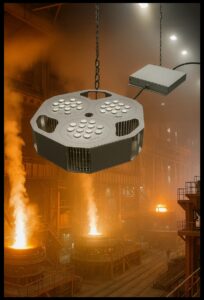
For lighting to be effective in continuous casting and hot rolling lines, it must meet several stringent requirements. First and foremost is high lumen output. Continuous casting areas require illumination levels sufficient to highlight molten steel flows, while hot rolling zones need clear visibility for surface inspection and machinery operation. Recommended lux levels typically range from 300–500 lux for general production zones and up to 1,000 lux in inspection areas where detail recognition is critical. High lumen output ensures that operators can detect defects or hazards promptly, improving safety and product quality.
Durability is equally important. Lighting fixtures must withstand high ambient temperatures, dust, moisture, and vibration. Industrial-grade housings made from aluminum or stainless steel, combined with tempered glass or polycarbonate lenses, provide resistance to mechanical impact and thermal stress. The fixtures must meet minimum IP ratings, such as IP66 or IP67, ensuring dust-tight and water-resistant performance. In areas where molten metal splatter is possible, heat-resistant and shatterproof materials are essential.
Another crucial requirement is color rendering. The Color Rendering Index (CRI) should be at least 70–80 for general operations and 80+ in inspection areas, enabling accurate perception of steel color and surface defects. Uniform light distribution is also critical, as shadows or glare can obscure critical areas of operation. Anti-glare optics and diffuser designs help achieve even illumination across the entire work area.
Maintenance-friendly design is a key consideration. With continuous operations, fixture failure can disrupt production, so modular designs allowing for quick replacement of individual components are preferred. Long lifespan lighting, such as LED fixtures rated for 50,000–100,000 hours, minimizes maintenance intervals and labor costs. Finally, energy efficiency is increasingly important. LED lighting, in combination with intelligent controls such as motion sensors, dimming, and scheduling, can reduce energy consumption by 50–70% compared to traditional metal halide or fluorescent lighting systems.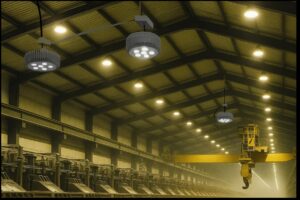
Selecting the appropriate lighting technology is critical to meet the demanding requirements of continuous casting and hot rolling lines. LED high bay lights are currently the most effective choice for main production areas. These fixtures provide high lumen output (ranging from 15,000 to 100,000 lumens), energy efficiency, long operational life, and minimal heat generation. High bay LED fixtures are designed to withstand high ambient temperatures and often feature advanced thermal management systems to maintain optimal performance under continuous use. For example, a typical continuous casting line may use LED high bay fixtures rated 150–300W per unit, mounted at 6–12 meters above the floor, achieving uniform illumination while minimizing shadows.
In zones exposed to molten metal, explosion-proof and heat-resistant fixtures are essential. These fixtures are constructed with reinforced housings and tempered glass, often rated to operate safely near high-temperature environments or flammable materials. Fixtures with IK10 impact resistance provide additional protection against mechanical damage from slag or debris.
Linear LED fixtures are recommended along conveyor lines and operator walkways to provide uniform illumination where precise visibility is required. Linear LEDs with 120–150 lumens per watt efficiency can maintain consistent lux levels while consuming minimal energy. These fixtures are particularly useful for continuous inspection areas and maintenance paths, ensuring that operators can navigate safely.
For temporary or inspection purposes, portable and adjustable lighting solutions allow flexibility. LED floodlights or adjustable work lights, mounted on mobile stands, can illuminate specific zones during maintenance or troubleshooting operations. Finally, smart lighting controls enhance overall efficiency. Integrating dimming capabilities, occupancy sensors, and programmable schedules with plant automation systems allows operators to adjust lighting based on real-time operational needs, reducing energy consumption without compromising safety or visibility.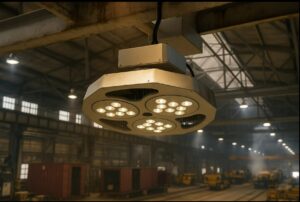
Effective lighting design in steel production lines requires careful planning and precise engineering. Illumination levels must be tailored to the specific task and zone. Continuous casting areas typically require 300–500 lux for general operations and up to 1,000 lux in inspection zones. Hot rolling lines may require 400–600 lux, with higher lux levels in quality control stations. Fixture placement is critical; lights should be mounted at heights and angles that minimize shadows, reduce glare, and ensure even coverage across all work areas.
Glare reduction is essential for operator safety. Bright reflections from molten steel, shiny machinery, and polished floors can impair vision, leading to accidents. Anti-glare optics, diffusers, and indirect lighting strategies mitigate this risk. Thermal management is another key consideration, especially for LED fixtures. High ambient temperatures can reduce efficiency and lifespan, so fixtures must incorporate heat sinks and thermal protection systems to maintain performance.
Redundancy and backup lighting are necessary for continuous operation. Critical areas should have dual circuits or backup fixtures to prevent total loss of illumination in case of fixture failure. Electrical planning should also consider voltage drops and surge protection, as industrial environments with heavy machinery often experience electrical fluctuations.
Additionally, integration with automation and monitoring systems enhances operational control. Sensors and smart controls allow dynamic adjustment of lighting intensity based on production status, ambient light conditions, or occupancy. These technologies reduce energy consumption, optimize maintenance schedules, and provide real-time diagnostics for predictive maintenance, improving both efficiency and reliability.
A leading steel manufacturer upgraded its continuous casting line with high-lumen LED high bay lights in 2023. The installation replaced metal halide fixtures with 200W LED units mounted 10 meters above the floor. As a result, the plant achieved uniform illumination of 450–500 lux across the casting area, improving defect detection and operator safety. Energy consumption decreased by 60%, reducing annual electricity costs by $120,000, while maintenance intervals were extended due to the long lifespan of LEDs (estimated 80,000 hours).
In a hot rolling line, a different steel plant implemented linear LED fixtures along conveyor lines combined with portable LED inspection lights for maintenance. This setup enabled operators to identify surface irregularities in hot steel slabs more accurately, reducing rejected products by 8%. The lighting upgrade also improved safety by eliminating dark zones near machinery and walkways.
These examples demonstrate the tangible benefits of industrial-grade lighting solutions in steel production: improved visibility, enhanced safety, energy efficiency, and reduced maintenance costs. Practical implementation involves selecting fixtures with appropriate heat resistance, mounting height, and optical design to match the specific environment of each production zone.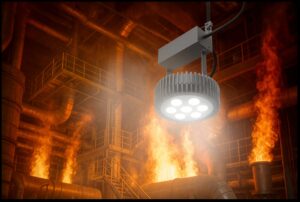
Maintenance planning is vital for ensuring continuous lighting operation in steel plants. Scheduled inspections and cleaning prevent dust and fume accumulation on fixture lenses, which can significantly reduce illumination. Modular fixture designs facilitate quick replacement of components, minimizing downtime. For high-risk zones, redundancy should be incorporated through dual-circuit lighting or backup units to prevent complete loss of illumination in case of fixture failure.
Remote monitoring and smart diagnostics enhance reliability. IoT-enabled lighting systems provide real-time data on fixture status, energy usage, and potential failures, allowing predictive maintenance before disruptions occur. Selecting reputable suppliers with robust industrial warranties ensures access to replacement parts and technical support, critical for maintaining continuous operation in 24/7 production environments.
In addition, staff training is essential. Operators should be trained to identify lighting issues, such as flickering, dimming, or physical damage, and respond appropriately. Integrating maintenance logs into plant management software allows for historical tracking, helping engineers make informed decisions regarding fixture upgrades or replacements. Overall, a comprehensive maintenance strategy extends the lifespan of lighting installations, ensures safety, and supports continuous production efficiency.
Reliable lighting is a cornerstone of operational safety, efficiency, and quality control in continuous casting and hot rolling lines. The harsh conditions of steel production—including extreme temperatures, dust, vibration, and molten metal hazards—demand carefully designed, durable, and high-performance lighting systems. Industrial-grade LED high bay lights, linear fixtures, and heat-resistant explosion-proof fixtures are the most suitable solutions, offering high lumen output, long lifespan, and energy efficiency.
Strategic fixture placement, glare reduction, thermal management, and redundancy ensure consistent illumination across all operational zones. Integration with smart lighting controls further enhances energy efficiency and operational flexibility. Real-world case studies highlight significant improvements in safety, defect detection, energy savings, and maintenance efficiency achieved through proper lighting upgrades.
By prioritizing these principles, steel manufacturers can ensure reliable, safe, and efficient lighting for continuous casting and hot rolling operations, supporting both productivity and long-term operational sustainability.
Recommended Lighting Specifications by Zone
| Zone | Lux Level | CRI | Fixture Type | IP Rating | Notes |
| Continuous Casting General Area | 300–500 | 70–80 | LED High Bay, 150–300W | IP66/IP67 | Mounted 6–12m, even distribution |
| Casting Inspection Zone | 800–1,000 | 80+ | LED High Bay with diffusers | IP66/IP67 | Anti-glare optics, uniform illumination |
| Hot Rolling Line General Area | 400–600 | 70–80 | LED High Bay, 200–400W | IP66/IP67 | Heat-resistant housing |
| Rolling Inspection & QC | 800–1,200 | 80+ | Linear LED fixtures, portable LEDs | IP66 | Portable lights for close inspection |
| Walkways & Maintenance Paths | 200–400 | 70+ | Linear LED fixtures, adjustable | IP66 | Even illumination, glare reduction |
–The End–