
Industrial processes involving high-temperature operations, such as ceramic firing, metal annealing, glass melting, and thermal curing, demand precision, efficiency, and safety. One often overlooked but critical component in these operations is proper lighting. Adequate illumination within tunnel kilns, drying lines, and high-heat chambers not only facilitates accurate monitoring of production processes but also ensures worker safety in environments where visibility is inherently compromised due to intense heat, limited access, and confined spaces.
Lighting in such environments directly affects the ability to conduct inspections, detect defects, and make timely adjustments, which can translate into improved product quality and reduced waste. Additionally, poorly designed lighting systems can exacerbate operational hazards, including slips, trips, and mismanagement of high-temperature machinery. Industrial-grade lighting solutions, particularly those based on high-performance LED technology, are increasingly being recognized for their ability to provide durable, energy-efficient, and heat-resistant illumination capable of withstanding harsh conditions.
Modern high-temperature lighting must satisfy multiple industrial criteria simultaneously. It must be thermally stable, resistant to dust and moisture, and capable of delivering uniform illumination without significant degradation over time. Beyond operational functionality, the energy efficiency of lighting solutions has become a critical factor as manufacturers strive to reduce operational costs while meeting environmental and sustainability standards. This article explores the technological challenges, requirements, and state-of-the-art lighting solutions for tunnel kilns, drying lines, and high-heat chambers, offering a comprehensive guide for industrial engineers, facility managers, and lighting designers seeking to optimize high-temperature production environments.
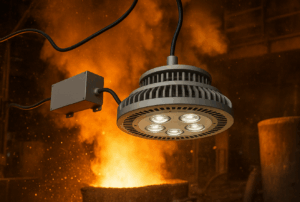
Lighting installations in high-temperature industrial settings face unique and multifaceted challenges. Tunnel kilns, drying lines, and thermal chambers often operate at temperatures ranging from 90°C to over 200°C, creating a hostile environment that standard lighting technologies cannot withstand. At these temperatures, traditional lighting solutions such as fluorescent or incandescent lamps degrade rapidly, leading to frequent maintenance cycles and increased operational downtime. Additionally, high thermal radiation emitted from furnaces and kilns can further compromise lamp materials, wiring insulation, and optical components, accelerating wear and reducing luminous efficacy.
Environmental contaminants such as dust, particulate matter, and chemical residues further complicate lighting requirements. Drying lines in ceramics and metal processing facilities often produce fine powders that can settle on lamps, reducing light output and potentially causing electrical failures. Similarly, high-heat chambers used in metal forging or glass production expose lighting units to intermittent thermal shocks, moisture condensation, and corrosive vapors, all of which can damage conventional luminaires. Access limitations are another critical challenge: many industrial high-heat installations feature confined spaces where personnel cannot perform frequent maintenance without interrupting production, making lamp longevity a paramount concern.
Moreover, heat-induced stress can lead to deformation of lamp housings, lens discoloration, and even catastrophic failure in extreme cases. Beam angles must be carefully engineered to prevent shadowing, as uneven illumination can compromise quality control inspections. High ambient temperatures can also affect the electrical performance of lighting drivers, requiring thermal management strategies such as heat sinks, protective housings, and specialized driver circuitry. These combined challenges necessitate a holistic approach to industrial lighting design, prioritizing thermal resilience, mechanical robustness, and consistent luminous performance over traditional metrics such as initial cost alone.
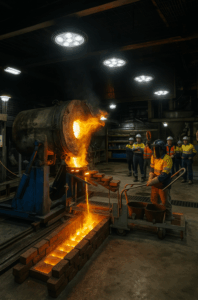
Effective lighting for high-temperature industrial environments must meet several critical technical requirements to ensure performance, safety, and operational longevity. Foremost among these is temperature resistance. Industrial lighting designed for kilns, drying lines, and high-heat chambers must tolerate continuous exposure to temperatures of 90°C, 150°C, or even 200°C. This requires the use of high-grade materials for housings, lenses, and internal electronics, as well as thermal management systems such as integrated heat sinks or external cooling fins. LED luminaires, when properly engineered for these conditions, maintain stable luminous output without degradation, whereas traditional lamps would fail within weeks or months.
Ingress protection is equally critical. Ratings of IP65 or higher ensure that lighting units are sealed against dust, moisture, and particulate infiltration. This is particularly important in drying lines or dusty kiln environments, where airborne particles can accumulate on optical surfaces and diminish light output. In high-humidity chambers, water condensation can lead to short circuits or corrosion if protective housings are inadequate.
Another key factor is luminaire efficiency. High-lumen output per watt (lm/W) is essential not only for energy savings but also for minimizing the number of fixtures required to achieve adequate illumination. Optimizing light distribution is equally important: beam angles must be tailored to the geometry of the workspace. Narrow beam angles are ideal for focused inspection points, while wider beam angles provide uniform coverage over linear drying lines or large chamber interiors.
Color temperature and color rendering (CRI) are additional considerations, particularly in processes requiring visual quality inspection. A color temperature range of 3000K–5600K ensures that operators can accurately distinguish material shades, detect defects, and monitor chemical reactions. Finally, durability and ease of maintenance are paramount. Lighting units must be designed for continuous operation, with modular components or replaceable drivers to minimize downtime and operational disruption. Taken together, these requirements define a rigorous specification framework for high-temperature industrial lighting, guiding manufacturers and engineers toward reliable and efficient solutions.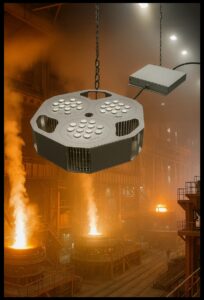
Tunnel kilns are continuous-processing systems used in ceramics, refractory materials, and other high-temperature industries. Lighting in these environments must withstand prolonged exposure to heat, often exceeding 150°C, while providing linear illumination along the length of the kiln. High-temperature linear LED modules are particularly suited for this application, as they combine thermal resilience with high luminous efficiency. These modules are often enclosed in thermally resistant housings that prevent heat degradation and dust ingress, ensuring stable performance over time.
Proper placement of lighting units is crucial for achieving uniform illumination. Fixtures are typically installed along the top or sidewalls of the kiln, maintaining a safe distance from the heat source to prevent direct thermal damage while ensuring consistent coverage. Beam angles should be selected based on the width of the kiln, with narrow-angle optics used for focused inspection areas and wide-angle optics for general illumination along the kiln conveyor. Additionally, protective coatings or quartz shields can be applied to lenses to resist discoloration caused by high-temperature radiation. Tunnel kiln lighting solutions increasingly incorporate modular designs, allowing individual units to be replaced without shutting down the entire system, thus minimizing production interruptions.
Drying lines, used in industries such as ceramics, textiles, and chemical processing, operate under moderate to high temperatures for extended periods. Lighting solutions for these lines must provide bright, even illumination to facilitate quality control and visual monitoring of drying progress. High-lumen, dustproof, and moisture-resistant LED strips are ideal for this purpose. They can be installed along conveyor sides or overhead rails to ensure that all product surfaces are adequately lit, preventing shadows that could obscure defects or inconsistencies.
The thermal environment in drying lines can vary along the production path, requiring luminaires that maintain consistent light output under fluctuating conditions. Heat-resistant wiring and IP65-rated housings are essential to protect against thermal expansion and dust accumulation. In addition, LED lighting can be paired with motion or occupancy sensors in automated drying lines to optimize energy consumption. By strategically spacing fixtures and selecting appropriate beam angles, designers can achieve a uniform light distribution that enhances both operator efficiency and product quality.
High-heat chambers represent some of the most extreme environments in industrial lighting applications. Metal forging, glass melting, and industrial baking processes can expose lighting units to radiant temperatures well above 200°C. Specialized UFO-type high-temperature LED luminaires are designed for these conditions. These fixtures feature thermally resistant housings, robust driver circuits, and optical lenses capable of withstanding thermal shock. Their compact, circular design facilitates installation in confined or overhead spaces while maximizing light output and minimizing shadow zones.
Mounting strategies for high-heat chambers focus on both safety and efficiency. Fixtures are often mounted at a safe distance from the heat source, with reflective shields or heat-resistant brackets to protect the unit from radiant energy. In some applications, optical accessories such as diffusers or reflectors are used to achieve uniform illumination across the chamber interior, enabling operators to monitor chemical reactions, product coloration, and structural integrity without opening the chamber. The combination of thermal resistance, optical precision, and long lifespan makes these high-temperature LEDs indispensable in modern industrial processes.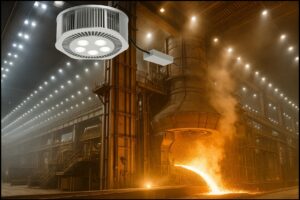
Modern LED lighting solutions provide a transformative set of benefits for high-temperature industrial operations. Energy efficiency is perhaps the most immediately measurable advantage, as LEDs convert a higher proportion of electrical energy into usable light compared to incandescent, halogen, or fluorescent lamps. This translates into substantial reductions in operational energy costs, particularly in facilities that operate 24/7. Additionally, high-efficiency LEDs generate less waste heat, reducing additional thermal load on the surrounding environment and minimizing the risk of heat-induced damage.
Another key advantage is enhanced lifespan. Industrial-grade LEDs are capable of tens of thousands of hours of continuous operation even under high-heat conditions. This longevity significantly reduces maintenance requirements and operational interruptions, which are critical considerations in continuous-process environments such as tunnel kilns and high-heat curing chambers. LEDs also offer precise light control, including dimming, beam shaping, and color temperature tuning, enabling operators to tailor illumination to specific production stages or inspection tasks.
Furthermore, LED luminaires can be seamlessly integrated into automated control systems, allowing centralized monitoring, scheduling, and fault detection. Their compact size, modularity, and robustness make them ideal for retrofitting older facilities, providing immediate improvements in visibility and safety without extensive infrastructure changes. Overall, the adoption of modern high-temperature LEDs enhances productivity, improves safety, reduces energy costs, and contributes to operational sustainability.
Proper installation and safety planning are integral to the success of high-temperature industrial lighting systems. Mounting strategies must account for thermal expansion, mechanical vibration, and potential contact with moving machinery. Common installation approaches include overhead mounting, sidewall placement, and modular rack systems, depending on the geometry and access limitations of the production area. Thermal shields or reflective barriers are often used to reduce radiant heat exposure, protecting both the lighting unit and surrounding equipment.
Safety compliance is another essential consideration. Lighting systems must meet industrial safety standards for electrical insulation, grounding, and protection against fire or thermal degradation. Wiring materials should be rated for high-temperature exposure, and drivers should incorporate thermal cutoffs or surge protection to prevent catastrophic failures. In high-risk areas, redundant systems or emergency lighting may be installed to maintain operational continuity during maintenance or fixture failure. Proper spacing and alignment of luminaires ensure uniform illumination while minimizing glare, shadows, or hot spots, all of which can compromise safety or quality control.
Regular inspection and preventive maintenance are recommended, even for high-durability LED systems, to detect early signs of wear, lens discoloration, or driver degradation. Modular or easily replaceable designs reduce downtime and allow maintenance to be conducted without halting production, further enhancing operational safety and efficiency.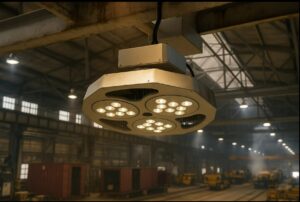
Ceramic Tile Kiln Installation (150°C-rated LEDs): A leading ceramic manufacturer retrofitted its tunnel kiln with 150°C-rated linear LED modules. These fixtures provided continuous illumination along the entire kiln length, enabling real-time monitoring of tile color and surface quality. Maintenance intervals were extended from three months to over 18 months, reducing operational downtime and energy costs by 35%.
Glass Production Line with 200°C UFO LEDs: A glass bottle manufacturer installed 200°C-rated UFO LED luminaires in its annealing chamber. The circular, thermally protected design provided uniform illumination across the chamber, allowing operators to detect micro-cracks and ensure consistent cooling rates. Energy consumption decreased by 40% while reducing lens degradation caused by heat and dust.
Food Processing Oven Lighting Retrofit: A commercial baking facility replaced incandescent fixtures with IP65-rated, high-temperature LED strips capable of withstanding 120°C. Operators reported improved visibility of dough expansion and color uniformity. The retrofit reduced energy costs by 50%, eliminated frequent lamp replacement, and improved compliance with hygiene standards due to sealed fixtures preventing contamination.
These examples highlight how customized high-temperature LED solutions enhance productivity, safety, and cost-efficiency across diverse industrial environments.
Lighting in high-temperature industrial environments is a critical factor that directly influences safety, productivity, and product quality. Tunnel kilns, drying lines, and high-heat chambers present unique challenges, including extreme temperatures, dust, moisture, and limited access for maintenance. Traditional lighting solutions are inadequate for such demanding conditions, often leading to frequent failures and increased operational costs.
Modern high-temperature LED technology offers an ideal solution, combining thermal resilience, energy efficiency, long lifespan, and precise illumination. By carefully selecting and installing LEDs with appropriate thermal ratings, IP protection, beam angles, and color temperatures, industrial operators can significantly enhance operational efficiency, safety, and product quality. Case studies from ceramic, glass, and food processing industries demonstrate the tangible benefits of adopting specialized LED solutions, including reduced downtime, lower energy consumption, and improved visual monitoring capabilities.
In conclusion, investing in high-quality, industrial-grade LED lighting for tunnel kilns, drying lines, and high-heat chambers is not merely a functional upgrade—it is a strategic decision that drives operational excellence, cost savings, and long-term sustainability in high-temperature manufacturing processes.
–The End–