Industrial operations in high-temperature environments face unique challenges, and one of the most critical yet often overlooked is lighting reliability. In hot zones such as foundries, steel mills, glass manufacturing facilities, and kiln operations, lighting failures are not merely inconvenient—they can trigger costly operational disruptions. Downtime resulting from lighting outages can halt production lines, reduce overall output, compromise worker safety, and generate unplanned maintenance expenditures. Standard lighting systems, including traditional LED fixtures and conventional HID lamps, often degrade quickly under these extreme conditions due to thermal stress. Drivers fail, lumens depreciate rapidly, housings warp, and electronic components become unstable, resulting in unexpected outages.
For industrial engineers, maintenance managers, and plant operators, this presents a significant risk: every hour of downtime carries a tangible financial impact. In addition to replacement costs, emergency interventions often require specialized labor, lifts or scaffolding, and potential shutdown coordination, further amplifying indirect expenses. High-temperature LEDs, purpose-engineered for these environments, are designed to mitigate these risks. By providing sustained luminous output and reliable operation under extreme heat, these fixtures reduce the frequency of maintenance interventions and prevent unplanned production stoppages. In essence, they transform lighting from a potential vulnerability into a strategic asset that supports operational continuity. For decision-makers, this translates into measurable cost savings, enhanced workplace safety, and a reduction in the total cost of ownership compared to conventional lighting solutions.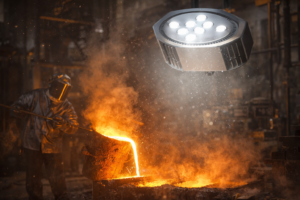
“Hot zones” refer to areas within industrial facilities that are subjected to elevated ambient temperatures, direct radiant heat, or continuous thermal exposure. These zones are challenging environments for any electrical system, including lighting, because excessive heat accelerates material degradation, electrical failure, and performance decline. Unlike standard warehouses or office spaces, hot zones require specialized lighting systems capable of maintaining performance in extreme thermal conditions.
Examples of hot zones span across multiple industrial sectors. In foundries and metal processing plants, molten metals emit extreme radiant heat that can exceed conventional fixture ratings. Steel mills expose high-bay lighting to radiant heat from rolling lines and reheating furnaces, often pushing ambient temperatures well beyond 90°C. Glass manufacturing facilities involve continuous exposure to thermal energy, particularly near annealing lehrs and kilns. Ceramic and tile production, industrial baking, curing chambers, and kiln operations also generate localized heat hot spots, creating challenging conditions for standard LED systems. Even boiler rooms, turbine halls, and certain areas of petrochemical plants are considered hot zones due to elevated ambient temperatures and continuous operational load.
Understanding the environmental conditions of these hot zones is critical when selecting industrial lighting. A fixture that performs well in a standard production facility may fail within weeks when exposed to a furnace-adjacent workflow or a high-temperature processing line. Engineers and procurement teams must evaluate both the thermal resistance rating of the fixture and its design features to ensure long-term reliability. Properly engineered high-temperature LED systems are purpose-built to withstand these conditions, delivering stable light output, operational longevity, and reduced downtime, even in the most thermally demanding industrial environments.
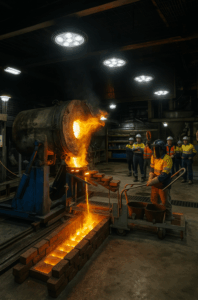
Standard lighting systems, including typical LED fixtures, metal halide lamps, or fluorescent solutions, often underperform and fail prematurely when exposed to high-temperature industrial zones. The primary cause of failure is thermal overload: electronic components, including drivers, chips, and connectors, degrade rapidly when operating above their rated temperature thresholds. Even minor increases in ambient temperature can accelerate the failure of driver circuitry, leading to flickering, lumen depreciation, or total fixture shutdown.
Another significant issue is housing integrity. Conventional fixture housings are often composed of materials not designed to tolerate sustained heat, resulting in deformation, seal failure, and potential ingress of dust or moisture. Additionally, standard fixtures rarely account for the combined stresses of vibration, humidity, and corrosive environments frequently found in industrial hot zones. This combination accelerates deterioration and reduces overall service life.
Operationally, lighting failures in hot zones carry consequences far beyond the cost of a replacement fixture. Maintenance interventions often require production line shutdowns, access equipment such as scaffolds or lifts, and labor coordination for safe installation and repair. These requirements make emergency replacements both costly and time-consuming. Furthermore, unreliable lighting in critical hot zones can compromise worker safety, reduce visibility in high-risk areas, and create compliance concerns in safety-regulated environments. As such, standard fixtures are not adequate for these demanding conditions. Only purpose-built high-temperature LED systems, designed to manage thermal stress and maintain operational stability, can effectively reduce downtime and support continuous industrial operations.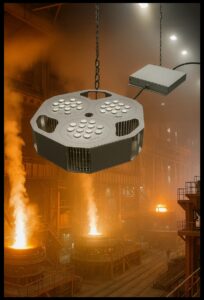
High-temperature LEDs are engineered to address the failure mechanisms associated with extreme industrial environments. These fixtures are specifically designed to operate under elevated ambient temperatures, resist thermal degradation, and provide consistent luminous output over extended periods. By maintaining stable operation, high-temperature LEDs significantly reduce the frequency of maintenance interventions and prevent unplanned outages, directly contributing to higher operational uptime.
The longevity of high-temperature LEDs is primarily achieved through advanced thermal management systems, including heat sinks with optimized surface area, thermally isolated drivers, and high-quality materials capable of withstanding sustained heat. These design strategies ensure that the LED chips and electronic components remain within safe operating temperatures, even when mounted near furnaces, kilns, or other high-heat machinery. In addition, robust housings protect the internal components from dust, moisture, vibration, and corrosive elements, further reducing the likelihood of premature failure.
From a practical perspective, high-temperature LEDs enable maintenance teams to transition from reactive to planned maintenance. Because the fixtures are less likely to fail unexpectedly, engineers can schedule inspections and replacements during planned downtime, minimizing disruptions to production. This reliability also improves worker safety, ensuring that critical hot-zone areas are consistently illuminated. For procurement teams, the result is a lower total cost of ownership, as fewer replacements, labor hours, and emergency interventions are required. Ultimately, high-temperature LEDs are not simply lighting solutions—they are operational tools that preserve continuity, protect assets, and enhance industrial productivity.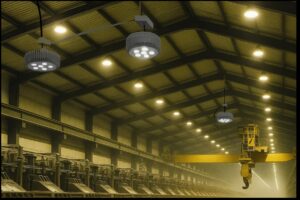
The maximum ambient temperature rating of an LED fixture is a critical parameter for evaluating suitability in hot zones. High-temperature LEDs are rated to operate reliably at temperatures significantly higher than standard fixtures, with typical ratings ranging from 90°C to over 200°C. The rating ensures that both the LED chips and driver electronics maintain stable performance without accelerated wear or failure. Industrial decision-makers must select fixtures whose temperature ratings exceed the highest expected environmental heat exposure to guarantee long-term reliability.
A fixture’s thermal rating directly impacts maintenance scheduling, expected lifespan, and overall operational efficiency. Installing LEDs with inadequate temperature ratings can result in frequent replacement cycles, production delays, and unplanned downtime. By selecting high-temperature-rated LEDs, facilities can maintain consistent illumination while reducing maintenance interventions, labor costs, and safety risks associated with insufficient lighting. In hot zones where ambient temperature fluctuates or occasionally spikes, a properly rated fixture offers both resilience and predictable performance, making it a key factor in downtime reduction strategies.
Thermal management is the cornerstone of high-temperature LED design. Efficient heat dissipation ensures that the LED chips and drivers operate within safe temperature ranges, preventing thermal-induced failures. Advanced heat sinks, constructed from high-conductivity aluminum alloys or composite materials, optimize heat transfer from the LEDs to the surrounding environment. Some fixtures incorporate fin geometries or airflow-optimized designs that facilitate passive cooling, maintaining stable temperatures even in confined or high-radiant-heat areas.
In addition, separating the driver from the heat source or using thermally insulated driver compartments minimizes thermal stress on electronic components. This approach extends fixture lifespan, reduces lumen depreciation, and prevents unexpected failures. Engineers evaluating high-temperature LEDs should carefully assess the thermal management strategy, as superior heat dissipation directly correlates with reduced downtime and lower maintenance frequency. In essence, a well-designed thermal system ensures that the fixture delivers consistent light output over the long term, even in the harshest industrial environments.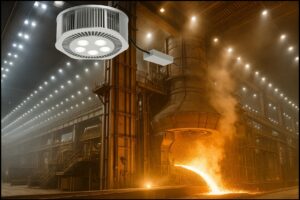
The driver is often the most vulnerable component of an LED fixture in high-temperature settings. Many high-temperature LEDs feature remote driver configurations or thermally isolated driver compartments to protect sensitive electronics from ambient heat. By relocating the driver away from the primary heat source or shielding it within a thermally insulated enclosure, these fixtures prevent overheating, voltage instability, and premature failure.
Remote driver solutions also improve maintainability. Maintenance teams can access drivers without climbing high scaffolds or interfering with production processes, minimizing labor costs and safety risks. Heat-isolated designs reduce the risk of emergency outages caused by thermal overload, enabling facilities to maintain uninterrupted lighting in critical areas. For engineers and procurement managers, fixtures with remote or insulated driver configurations are highly desirable for hot-zone applications, as they offer both reliability and serviceability, key elements in reducing downtime.
High-temperature LEDs are designed to withstand more than just heat. Durable housings made from corrosion-resistant aluminum or stainless steel protect internal components from dust, moisture, and physical impact. Many fixtures feature IP ratings suitable for harsh industrial environments, ensuring that contaminants do not compromise performance. Impact-resistant housings prevent damage during handling, installation, or accidental contact with machinery.
Vibration and thermal cycling are common in industrial hot zones, especially near heavy equipment or rotating machinery. Robust housing ensures structural integrity and maintains consistent optical alignment, which is critical for reliable illumination and worker safety. A fixture with inferior housing can fail mechanically, exposing internal electronics and necessitating emergency maintenance. Therefore, durable housing is not merely a design preference—it is a functional requirement for downtime reduction in thermally demanding facilities.
Maintaining consistent light output is essential in industrial hot zones. High-temperature LEDs are engineered for minimal lumen depreciation, ensuring visibility remains uniform across the fixture’s lifespan. Standard LEDs may lose significant light output over time, particularly when exposed to elevated temperatures, creating safety hazards and operational inefficiencies.
High lumen maintenance reduces the frequency of replacement and prevents uneven illumination that could impede workflow or violate safety regulations. For plant managers, this translates to fewer scheduled relamping interventions, reduced labor costs, and uninterrupted production. Engineers and safety teams benefit from predictable lighting performance, ensuring that critical areas remain well-lit for optimal operation. In high-heat environments, consistent luminous efficacy is a direct contributor to operational reliability and reduced downtime.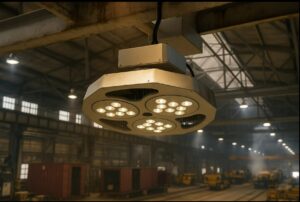
Reducing lighting downtime in industrial hot zones delivers benefits far beyond maintenance cost savings. Consistent and reliable illumination directly supports production continuity, worker safety, and operational efficiency. When high-temperature LEDs maintain performance, facilities avoid the indirect costs of emergency interventions, production delays, and safety incidents.
For operations teams, downtime reduction improves scheduling flexibility and minimizes unplanned interruptions, which can impact shift planning and throughput. Safety managers benefit from consistent visibility, which is essential for hazard detection, navigation, and compliance with occupational safety standards. Procurement and finance teams see reduced total cost of ownership due to lower fixture replacement frequency and minimized emergency labor expenditures.
High-temperature LEDs also contribute to strategic uptime planning. With reliable lighting, maintenance can be proactively scheduled during planned shutdowns, further minimizing operational disruptions. In essence, investing in purpose-built LED systems is not only a lighting decision—it is a critical component of an industrial uptime strategy, ensuring that production, safety, and cost efficiency are all optimized simultaneously.
High-temperature LED lighting provides exceptional value in areas where fixture access is difficult, replacement costs are high, or operational continuity is critical. Overhead lighting in foundries, furnace-adjacent production lines, steel rolling areas, and kiln loading zones are prime examples where conventional fixtures struggle. These environments combine elevated ambient heat, radiant thermal loads, dust, and vibration, creating conditions that quickly degrade standard lighting systems.
Other high-value applications include industrial baking chambers, heat treatment workshops, high-ceiling bays, turbine and generator rooms, and continuous process manufacturing areas. In each of these scenarios, the cost of unplanned downtime can far exceed the price of installing a premium high-temperature LED fixture. The more challenging the maintenance access and the higher the operational stakes, the greater the ROI of deploying LEDs designed for extreme heat environments. For industrial engineers and facility managers, these fixtures become strategic assets, ensuring that lighting supports continuous operation without compromising safety or efficiency.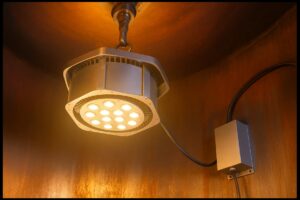
Selecting high-temperature LED fixtures requires careful evaluation. Buyers should consider multiple technical factors to ensure that the chosen fixtures will provide reliable operation in their specific hot-zone environment. Critical questions include:
By addressing these questions, buyers ensure that they invest in fixtures that deliver predictable performance, reduce emergency maintenance interventions, and provide maximum operational uptime.
No two hot zones are identical. Ambient temperature, radiant heat exposure, ceiling height, dust load, and operational cycles vary significantly across industrial facilities. Therefore, a one-size-fits-all lighting solution may underperform or fail prematurely. Customization ensures that fixtures are tailored to specific environmental conditions and operational requirements.
Customization options may include wattage selection, beam angle optimization, mounting style, voltage compatibility, thermal resistance level, and fixture size. Matching these parameters to the operational environment maximizes luminous efficacy, ensures thermal stability, and reduces maintenance frequency. High-temperature LEDs can also be engineered to meet specialized industrial standards, including explosion-proof or IP-rated enclosures, further enhancing reliability. Ultimately, a customized approach ensures that lighting not only illuminates the space but actively supports operational continuity and minimizes downtime.
In industrial hot zones, lighting is not just a utility—it is a critical operational component. High-temperature LED fixtures transform lighting from a potential vulnerability into a tool for reliability, productivity, and safety. By maintaining consistent performance under extreme thermal stress, these fixtures reduce maintenance requirements, prevent unexpected downtime, and ensure continuous illumination in demanding environments.
For industrial engineers, plant managers, and procurement teams, investing in purpose-built high-temperature LEDs represents a strategic decision. It safeguards operations, enhances worker safety, lowers total cost of ownership, and ensures that production processes remain uninterrupted. In high-heat applications where traditional lighting fails, high-temperature LED technology is not only a technical solution—it is an industrial uptime strategy.
–The End–