LED Lighting for Instant Replays and High-Speed Cameras in Football
I. Introduction
The spectacle of a football game has evolved immensely over the last few decades. Beyond the athletes and the roar of the crowd, there is a sophisticated technological environment working tirelessly to enhance every viewing experience. One of the most significant advances in this arena is the deployment of high-speed cameras capturing every second of play and instant replays that allow fans, referees, and commentators to review critical moments at will. None of this would be possible without the equally remarkable advances in lighting—especially the adoption of LED lighting.
Modern stadiums today rely on LED technology to enhance everything from the crispness of slow-motion replays to the color accuracy that gives televised football its cinematic quality. With sports broadcasts becoming more demanding and ultra-high-definition (UHD) formats becoming the norm, lighting must keep pace. This article explores how LED lighting plays a critical role in making instant replays and high-speed camera footage as vivid and precise as modern football audiences demand.
II. The Demands of High-Speed Football Coverage
Anyone who has watched a slow-motion replay of a last-second goal or an intricate tackle knows that these moments depend on a perfect combination of high-speed camera capability and lighting conditions. Without the proper light levels and color accuracy, these cameras cannot produce the ultra-slow, detailed images that fans and broadcasters rely on to make sense of every game-changing play.
High-speed cameras shoot at frame rates upwards of 1000 frames per second (fps), far higher than conventional television rates of 60 fps. This enables broadcasters to capture nuanced details like the exact moment a ball crosses the goal line or the subtle contact that prompts a foul. However, the higher the frame rate, the more light the camera requires. Poor lighting results in dark, grainy footage that is unsuitable for broadcast.
Traditional metal halide or fluorescent lighting systems often struggle under these conditions. Flicker rates become evident at higher frame rates, rendering them unusable for high-speed cameras. Poor color rendering and inconsistent light output further compound the problem. Broadcasters, in turn, face significant obstacles when attempting to produce the smooth, rich images viewers expect during slow-motion analysis.
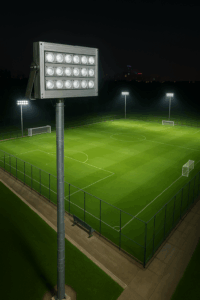
stadium light led
III. Why LEDs Are Ideal for Instant Replays
Flicker-Free Operation:
Traditional stadium lights often introduce flicker, especially at the microsecond level, which high-speed cameras pick up easily. This flicker is a result of the AC current that traditional lamps rely on, producing light that varies in intensity multiple times per second. LEDs, powered by constant-current drivers, eliminate this issue entirely. Flicker-free LED lighting ensures that every frame of a high-speed replay looks seamless.
Stable Color Temperature:
For replay footage to feel true-to-life, color accuracy matters immensely. LEDs are engineered to deliver a stable color temperature across their lifespan, often with CRI (Color Rendering Index) and TLCI (Television Lighting Consistency Index) ratings exceeding 90 or even 95. This provides broadcasters with more vibrant and accurate colors, ensuring that team uniforms, the green of the grass, and skin tones look as they should.
Instantaneous Light Output:
Traditional lamps often require warm-up time to achieve full output, making them unsuitable for quick changes between regular gameplay and slow-motion capture. LEDs, on the other hand, offer instant on/off capabilities. Whether it’s a paused replay or a quick highlight reel, LEDs can achieve full light output instantly with no delay.
IV. Advantages of LEDs for Broadcast and Camera Systems
Uniform Intensity and Coverage:
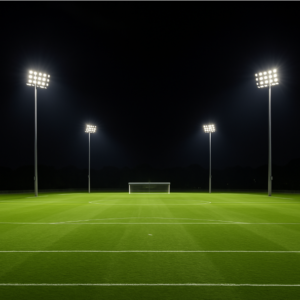
LED lighting designs for stadiums can provide uniform light across the entire playing surface. Proper light uniformity reduces glare and shadowing, which is especially important for cameras panning across the pitch. Even slight variations in light level can produce visible flicker when played back at extremely high speeds. LEDs maintain this consistency throughout every corner of the stadium.
Improved Contrast and Motion Capture:
With higher light intensity and uniformity, high-speed cameras can use faster shutter speeds. Faster shutter speeds reduce motion blur, allowing every fine detail of a player’s movements, ball rotation, or grass disturbance to be frozen with absolute clarity. This level of detail enriches slow-motion replays, allowing officials to make better decisions.
High Energy Efficiency and Output per Watt:
Modern stadium-grade LED fixtures achieve up to 160 lm/W and beyond. This energy efficiency means operators can increase light levels without increasing energy consumption dramatically, making LEDs not only a technical but also an economical upgrade.
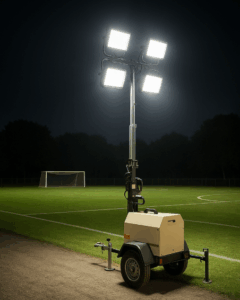
Light tower
V. Impact on Football Audiences and Broadcasters
Enhanced Viewer Experience:
High-speed, slow-motion footage is a fan favorite because it allows people to appreciate the skill and athleticism of players. Without good lighting, these moments lose their impact. LEDs contribute to creating razor-sharp footage that reveals intricate details of passes, catches, and collisions. The enhanced visual spectacle improves viewer satisfaction and keeps them engaged for the full broadcast.
Improved Officiating Accuracy:
Referees and officials often rely on replay footage to make decisions. Poor lighting can result in unclear images that lead to controversial or incorrect calls. With the consistency and color accuracy of LED lighting, even ultra-slow replays offer unambiguous images, reducing the potential for referee errors.
Better Sponsor Visibility:
Beyond the game itself, sponsors rely on sharp, vibrant broadcast footage to showcase their branding. Poor lighting can make logos on the pitch or players’ uniforms appear muddy and indistinct, diminishing the value of sponsorship deals. With well-lit scenes powered by LEDs, every sponsor’s logo shines clearly, whether displayed on the boards around the stadium or on the players themselves.
VI. Technical Considerations for Implementation
Light Positioning and Aiming:
High-speed cameras pick up every tiny shadow, so it’s important to plan light positions carefully. LEDs can be arranged in arrays to cover the field evenly, avoiding harsh shadows or uneven light spots. Sophisticated lighting layouts involve a mix of vertical and horizontal angles to achieve uniform light levels across every part of the pitch.
Addressing Shadows and Dark Spots:
Stadiums often have obstacles like scoreboard structures or grandstands that can cast shadows. LED fixtures with proper optics and shielding ensure these shadows are minimized. Combining adjustable beams with careful light planning can overcome these obstacles to provide uninterrupted illumination across the playing surface.
Synchronizing Light Frequency and Camera Frame Rates:
Although most stadium-grade LED fixtures are flicker-free, some attention must be given to their driver technology. Broadcasters need to verify that the light output is modulated at a frequency well beyond the operating frame rate of high-speed cameras—usually at tens of thousands of hertz. This synchronization ensures smooth footage with no unintended strobing or color banding.
VII. Case Studies & Examples
Major International Stadiums:
Numerous world-famous stadiums have adopted high-output LED fixtures to enhance their broadcast capabilities. For example, Wembley Stadium in London transitioned to LEDs specifically to support 4K UHD broadcasts. Post-installation, they noted vastly clearer high-speed camera footage with richer color depth.
Super Bowl Broadcasts:
The NFL requires state-of-the-art broadcast solutions for its flagship events like the Super Bowl. Stadiums such as SoFi Stadium in Los Angeles feature ultra-bright LED fixtures that ensure every slow-motion touchdown is captured in vivid detail. Broadcasters have reported up to a 40% reduction in image noise for ultra-slow replay footage after converting to LEDs.
Smaller Venues and Training Grounds:
Even regional or training venues are investing in LEDs. Coaches and players review slow-motion footage as part of their practice regimen. Properly illuminated high-speed footage improves training by allowing players to see fine-tuned techniques and coaches to give more precise feedback.
VIII. Future Developments
Smarter LED Systems:
Next-generation LED fixtures will come with embedded sensors and wireless controls allowing operators to adjust light output and color temperature dynamically. Imagine stadiums responding to real-time game situations, changing the light intensity for replays automatically or spotlighting specific sections of the field to focus attention on key plays.
Integration with Broadcast Tech:
As 8K cameras, VR/AR broadcasts, and AI-powered replays gain ground, LED lighting will need to evolve further. Systems will need to offer ultra-high output and color consistency tailored to new standards like Rec.2020 color gamut and High Dynamic Range (HDR).
Adaptive Sports Lighting:
Future developments could also incorporate automated tracking of player positions, lighting different areas of the pitch as action intensifies in one region, ensuring top lighting where cameras need it most.
IX. Conclusion
The interplay between lighting and camera technology is one of the most overlooked yet critical aspects of modern sports broadcasts. LED lighting for instant replays and high-speed cameras in football provides fans with more exciting, clearer footage, enhances referee accuracy, and boosts commercial value through better branding visibility.
As football and sports entertainment continue to embrace ever-higher standards of broadcast quality, lighting will remain one of the most important factors driving the viewer experience. The investment in modern LED systems is not just about reducing energy consumption or improving sustainability; it’s about allowing the beauty of sport to be captured at its very best.