
Industrial lighting has always been a mission-critical component of production environments, yet it is often one of the most underestimated systems when facilities operate under extreme thermal conditions. Foundries, metal smelting plants, glass manufacturing lines, ceramic kilns, power plants, and military installations expose lighting fixtures to sustained high ambient temperatures, radiant heat, thermal cycling, and aggressive contaminants. Under these conditions, lighting performance is not merely about illumination—it directly affects safety, productivity, maintenance planning, and operational continuity.
Historically, traditional lighting technologies such as metal halide (MH), high-pressure sodium (HPS), fluorescent, and halogen fixtures dominated high-bay and industrial applications. These systems were widely adopted because they could tolerate relatively harsh environments and offered high lumen output per fixture. However, their performance deteriorates rapidly under thermal stress, leading to frequent failures, unstable light quality, and escalating maintenance costs.
In contrast, the emergence of purpose-built high-temperature LED lighting systems has fundamentally changed how engineers approach illumination in extreme environments. Unlike early-generation LEDs—many of which failed prematurely when exposed to heat—modern high-temperature LEDs are designed from the ground up to operate reliably at ambient temperatures ranging from 90°C to 200°C and beyond, provided that proper thermal management strategies are applied.
This article presents a comprehensive, engineering-level comparison between high-temperature LED fixtures and traditional lighting technologies, focusing specifically on their performance under sustained thermal stress. Rather than theoretical specifications alone, the analysis integrates thermal physics, component-level behavior, real-world degradation mechanisms, and field-proven case studies to help decision-makers understand where each technology succeeds—or fails—when pushed to its limits.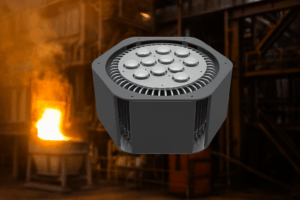
In industrial lighting design, “high temperature” does not refer to a single numeric threshold. Instead, it describes a range of environmental conditions where ambient or localized temperatures exceed what conventional lighting fixtures are designed to tolerate over long periods.
Most commercial and warehouse lighting systems are rated for ambient temperatures of 25°C to 40°C. Industrial environments, however, frequently exceed these limits. High-temperature zones may involve:
From a lighting engineering perspective, these conditions are particularly challenging because temperature affects not only the light source but every component in the system, including drivers, ballasts, wiring insulation, lenses, seals, and mounting hardware.
Temperature alone rarely acts in isolation. In real-world facilities, lighting fixtures are subjected to a combination of stress factors that accelerate degradation:
The combined effect of these stresses is often far more damaging than high temperature alone, making real-world performance significantly worse than laboratory ratings suggest.
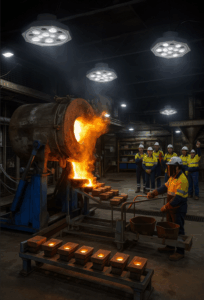
Traditional industrial lighting technologies share one defining characteristic: they rely on high-temperature processes to generate light.
Metal halide and high-pressure sodium lamps produce light through electric arcs within gas-filled tubes, operating at extremely high internal temperatures. Fluorescent lamps rely on mercury vapor excitation, while halogen lamps use incandescent filaments enclosed in quartz envelopes to withstand elevated operating temperatures.
For decades, these technologies were considered suitable for harsh environments because their basic operating principles already involved heat. However, this assumption overlooks the fact that external ambient temperature directly affects system stability, efficiency, and safety.
Traditional fixtures generate significant heat internally and depend heavily on surrounding air to dissipate it. As ambient temperature rises, their ability to reject heat diminishes, causing internal temperatures to increase even further.
Ballasts—whether electromagnetic or electronic—are especially vulnerable. Elevated temperatures accelerate insulation breakdown, capacitor degradation, and magnetic core losses. As a result, even if the lamp itself survives, ballast failure often renders the entire fixture inoperable.
Under sustained thermal stress, traditional fixtures exhibit predictable failure patterns:
These failure modes make traditional fixtures increasingly impractical as operating temperatures rise.
A critical distinction must be made between standard LED fixtures and high-temperature LED systems. While standard LEDs are efficient and long-lasting in controlled environments, they are not inherently suitable for extreme heat.
High-temperature LED fixtures are engineered systems, not merely upgraded versions of commercial LEDs. They are designed to manage heat proactively rather than passively tolerate it.
Key design strategies include:
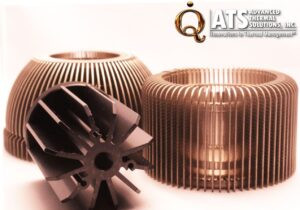
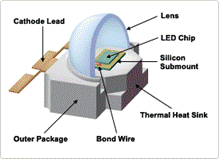
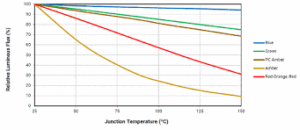
Unlike traditional lamps, LED performance is directly tied to junction temperature (Tj). High-temperature LED designs carefully control the thermal path from the LED chip to the ambient environment, ensuring that Tj remains within safe limits even when ambient temperatures are extreme.
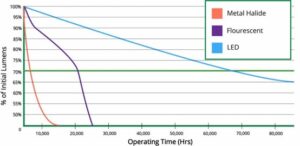
Traditional lamps suffer exponential lumen loss as temperature increases. Metal halide lamps, for example, may lose up to 50% of usable light output when operated continuously in high-temperature zones.
High-temperature LEDs, by contrast, exhibit gradual and predictable lumen depreciation, provided thermal limits are respected. This stability allows engineers to design lighting systems based on long-term performance rather than initial brightness alone.
As temperatures rise, traditional ballasts experience increased electrical losses, reducing system efficiency. LEDs, when properly thermally managed, maintain far higher efficacy under the same conditions.
Color shift is a common complaint in traditional systems operating under heat stress. LEDs offer exceptional CCT and CRI stability, which is critical for visual inspection, quality control, and safety signaling.
Traditional discharge lamps require warm-up and restrike times that become longer and less reliable in hot environments. LEDs deliver instant-on, full-output performance, even at elevated temperatures.
6.1 Rated Life vs. Reality
Traditional lamp lifetimes are heavily de-rated in high-temperature environments, often falling to 30–40% of nominal ratings. High-temperature LEDs, by contrast, are rated based on realistic thermal operating conditions, making their lifespan claims far more reliable.
6.2 Component-Level Durability
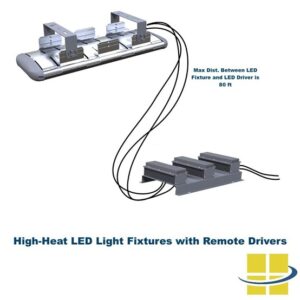
Ballasts remain the weakest link in traditional systems. In LED fixtures, drivers are the critical component—but high-temperature designs mitigate this through remote placement and thermal isolation.
6.3 MTBF Analysis
Field data consistently shows significantly higher MTBF values for high-temperature LED systems compared to traditional fixtures in identical environments.
7.1 Maintenance Frequency
Frequent relamping and ballast replacement in traditional systems increase labor costs and expose maintenance personnel to hazardous environments. High-temperature LEDs dramatically reduce intervention frequency.
7.2 Downtime and Safety
Lighting failures in critical zones can halt production or compromise safety. LED reliability directly improves operational continuity.
7.3 Logistics and Spare Parts
LED systems simplify inventory management by eliminating lamp-type diversity and reducing spare part requirements.
8.1 Real-World Energy Performance
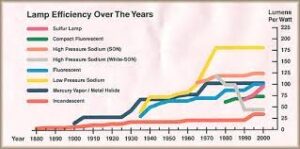
When operating in hot environments, traditional fixtures consume more power for less light. High-temperature LEDs maintain superior lumens per watt under stress.
8.2 Total Cost of Ownership (TCO)
Although initial LED investment may be higher, lifecycle analysis consistently favors high-temperature LEDs due to energy savings, reduced maintenance, and longer service life.
8.3 ROI in Extreme Environments
In foundries and glass plants, payback periods of 18–36 months are common when upgrading to high-temperature LED systems.
In high-temperature industrial environments, lighting system safety extends far beyond basic illumination performance. It plays a critical role in protecting personnel, ensuring uninterrupted operations, and meeting stringent regulatory requirements. Traditional lighting technologies such as metal halide and high-pressure sodium lamps pose inherent safety risks under thermal stress. As ambient and radiant temperatures increase, internal arc tube pressure rises, accelerating material fatigue and significantly increasing the likelihood of lamp rupture or glass shattering. In facilities handling flammable materials, fine dust, or volatile gases, such failures can escalate into fire hazards or secondary industrial accidents.
High-temperature LED lighting systems offer a fundamentally safer alternative due to their solid-state light generation and lower operating voltages. Purpose-built high-temperature LED fixtures eliminate pressurized arc tubes and fragile filaments, reducing the risk of explosive failure. In addition, these systems are typically engineered with heat-resistant housings, reinforced lenses, and multi-layer thermal and electrical protection mechanisms. From a compliance perspective, high-temperature LEDs are better aligned with modern safety standards, including IEC, UL, and CE requirements, and can be more readily adapted to meet region-specific industrial or hazardous-area regulations. This combination of intrinsic safety and predictable thermal behavior makes high-temperature LED systems a preferred choice in safety-critical environments.
A European steel mill replaced 400W metal halide fixtures with 200W high-temperature LED high bays. Maintenance calls dropped by 70%, while energy consumption fell by 45%.
LED fixtures with ceramic heat shields maintained stable output where HPS lamps failed within months.
LEDs enabled continuous operation without restrike delays, improving throughput consistency.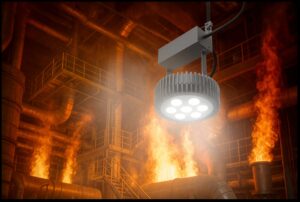
Despite their superior performance in extreme environments, high-temperature LED lighting systems are not immune to failure if improperly specified or installed. One of the most common mistakes is deploying standard industrial LED fixtures in applications where ambient temperatures exceed their rated limits. While LEDs themselves can tolerate relatively high junction temperatures, the supporting components—particularly drivers, capacitors, wiring insulation, and optical materials—often represent the true thermal bottlenecks. Without appropriate high-temperature ratings, these components degrade rapidly, negating the expected lifespan advantages of LED technology.
Effective high-temperature LED deployment requires a system-level design approach. This includes accurate assessment of ambient and radiant heat exposure, selection of fixtures with verified thermal ratings (such as 90°C, 150°C, or 200°C), and careful consideration of mounting location and airflow conditions. In many extreme applications, remote driver configurations are essential to isolate sensitive electronics from heat sources. Additionally, shielding from direct radiant heat and allowance for natural or forced convection can significantly influence long-term performance. When these factors are overlooked, even advanced LED systems may experience accelerated lumen depreciation or premature failure.
The field of high-temperature industrial lighting continues to evolve as advances in materials science, electronics, and digital control technologies expand the operational limits of LED systems. Ongoing development in LED chip architecture, including the use of more thermally stable substrates and improved phosphor formulations, is enabling higher junction temperature tolerance without compromising light quality or efficiency. At the same time, next-generation driver electronics are being designed with wide-temperature-range components and enhanced thermal protection, further improving system resilience.
Beyond hardware improvements, the integration of smart monitoring and control technologies represents a significant future trend. High-temperature LED fixtures are increasingly being equipped with temperature sensors, operating-hour tracking, and predictive diagnostics that allow maintenance teams to identify potential issues before failure occurs. This data-driven approach supports condition-based maintenance strategies, reducing unplanned downtime in critical facilities. As industrial operations place greater emphasis on energy efficiency, safety, and digitalization, high-temperature LED lighting is expected to play an increasingly strategic role—not only as an illumination solution, but as an integrated component of intelligent industrial infrastructure.
When evaluated under real thermal stress, high-temperature LED lighting clearly outperforms traditional fixtures in reliability, efficiency, safety, and total cost of ownership. While traditional systems may still persist in legacy installations, the long-term trend is unmistakable: purpose-built high-temperature LEDs are becoming the industrial standard.
–The End–