
Large-area outdoor lighting is one of the most demanding segments in the lighting industry. Applications such as container ports, open-pit mines, airports, logistics hubs, highway interchanges, and industrial parks require lighting systems that deliver not only high brightness, but also precision optical control, structural durability, and long-term operational reliability.
High power LED lighting systems, particularly those designed for high pole (high mast) installation, have become the preferred solution for these environments. However, true performance in large-area lighting is not defined by wattage alone. It is the combination of high lumen output and precision optical engineering that determines whether a project achieves safety, efficiency, and cost-effectiveness.
This article explores the technical foundations, design considerations, and performance advantages of high power LED luminaires engineered specifically for high pole and large-area outdoor lighting.
High pole lighting typically involves mounting heights ranging from 20 meters to 50 meters, and in some specialized installations, even higher. At these elevations, lighting fixtures must project illumination across substantial horizontal distances while maintaining adequate ground-level illuminance.
Unlike low-height street lighting, high mast lighting requires:
Long throw beam control
Controlled vertical and horizontal illuminance
Minimal light loss over distance
Reduced glare at high viewing angles
Improper optical design at high mounting heights leads to wasted light, hotspots directly below the pole, and insufficient illumination in outer zones.
Large-area lighting applications often span tens of thousands of square meters. For example:
Container terminals with extensive stacking zones
Open-pit mines with terraced excavation levels
Airport aprons requiring aircraft maneuvering visibility
Industrial yards with heavy truck movement
Uniform coverage across these expansive areas is essential. Lighting must eliminate dark pockets while avoiding excessive overlap that increases glare and energy waste.
Outdoor industrial lighting operates in harsh conditions:
Salt spray and humidity in coastal harbors
Dust and vibration in mining environments
High wind loads at elevated mast installations
24/7 operational requirements
Lighting systems must maintain structural integrity, stable luminous output, and electrical reliability under these stress factors.
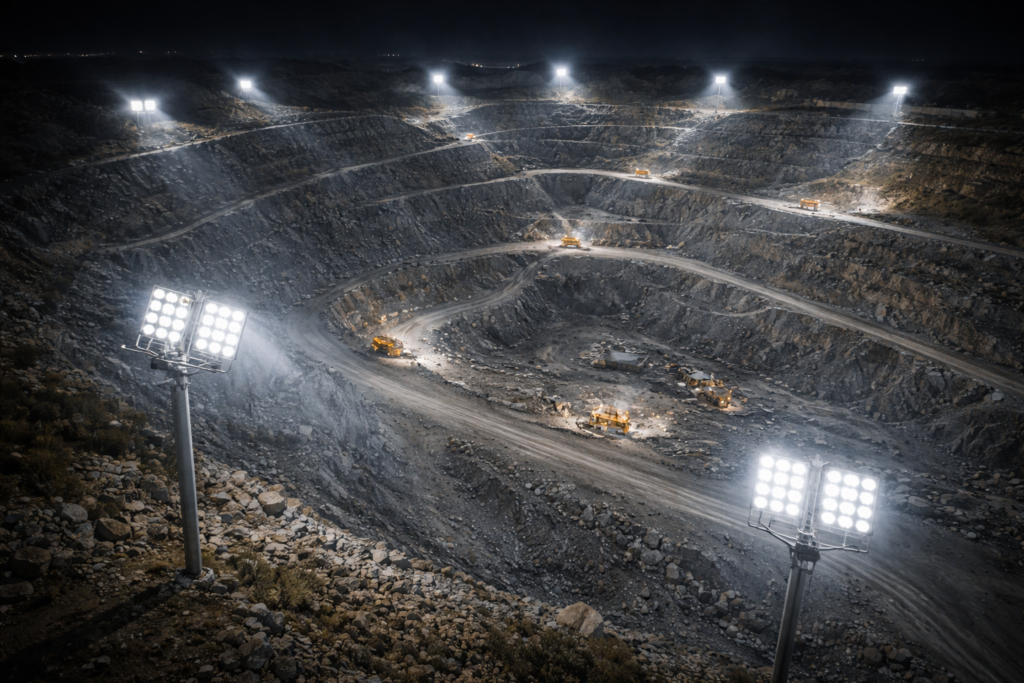
High power LED luminaires for large-area lighting typically range from 600W to 1500W or higher, delivering total luminous flux exceeding 90,000–200,000 lumens depending on configuration.
However, the key metric is not merely rated wattage—it is effective luminous output delivered to the target surface.
At mounting heights of 30–40 meters, light must travel significant distances. Insufficient lumen output results in:
Low ground-level lux
Poor visibility for equipment operators
Increased fixture quantity requirements
High lumen systems reduce the number of poles required, simplifying infrastructure and lowering capital expenditure.
Modern high power LED systems achieve luminous efficacy exceeding 140–170 lm/W, depending on configuration. However, system efficiency must consider:
Optical transmission losses
Driver efficiency
Thermal performance
Real-world operating temperature
Effective lumen output (delivered lumens after optical losses) determines actual project performance.
While high lumen output enables reach, precision optical engineering determines control.
Without precise optical control, high wattage fixtures can create:
Excessive glare
Light spill beyond site boundaries
Uneven distribution
Energy waste
Precision optics ensure that light is directed exactly where it is needed.
High power LED luminaires incorporate engineered lens systems designed for specific distribution types:
Narrow beam (10°–30°) for long-distance projection
Medium beam (40°–60°) for balanced coverage
Wide beam (90°+) for area flood lighting
Asymmetric optics for directional applications
In high mast installations, a combination of beam angles is often used on a single pole to create layered coverage.
Large-area lighting design relies on controlled beam overlap between adjacent poles. Proper overlap achieves:
Smooth illuminance transition
Reduced hotspot intensity
Improved uniformity ratios
Balanced horizontal and vertical illumination
This engineering approach minimizes sharp contrasts and shadow zones.
Uniform lighting directly impacts:
Equipment operator safety
Driver reaction time
CCTV camera performance
Visual comfort
Human vision performs best under consistent illumination levels. Extreme contrast between bright and dark zones increases fatigue and reduces situational awareness.
In professional lighting design, uniformity is measured using ratios such as:
Emin / Eavg (Minimum to average illuminance)
U1 (Minimum to maximum ratio)
U2 (Minimum to average ratio)
Higher uniformity values indicate smoother distribution. Precision optical design improves these metrics significantly compared to uncontrolled flood lighting.
In applications like harbors and mining sites, vertical illuminance is equally important. Equipment operators and surveillance systems require vertical lighting to clearly identify containers, vehicles, and structural elements.
Proper beam aiming and optical distribution enhance both horizontal and vertical lighting performance.
High pole installations expose fixtures to strong wind forces and vibration. Structural requirements include:
Die-cast aluminum housing
Reinforced mounting brackets
High wind resistance design
Anti-corrosion coating for coastal environments
Modular luminaire design improves mechanical stability and simplifies maintenance.
High power LEDs generate substantial heat. Without efficient thermal management, luminous efficacy decreases and lifespan shortens.
Engineering solutions include:
Integrated fin heat sinks
Optimized airflow channels
High thermal conductivity materials
Separated driver compartments
Maintaining low junction temperatures ensures stable lumen maintenance and long operational life.
Industrial environments demand robust ingress protection. High power LED luminaires for large-area lighting typically feature:
IP65 / IP66 / IP67 ratings
Sealed optical chambers
Anti-corrosion surface treatment
UV-resistant lens materials
In coastal ports, corrosion resistance is critical. In mining sites, dust sealing protects internal components.
Compared to metal halide or high-pressure sodium systems, high power LED solutions offer:
50–70% energy savings
Instant start capability
No warm-up or restrike delay
Improved lumen maintenance
Traditional HID systems suffer from lumen depreciation and long restart times, limiting operational flexibility.
High mast installations are expensive to service. Access often requires lift equipment and operational downtime.
LED systems provide:
50,000–100,000+ hour lifespan
Reduced lamp replacement frequency
Lower maintenance labor cost
Improved reliability in 24/7 operations
Lower lifecycle costs significantly improve total return on investment.
Modern high power LED systems support:
Dimming controls
Motion or schedule-based control
Remote monitoring
Energy consumption tracking
Smart lighting allows operators to reduce output during low-activity periods, further improving efficiency.
Ports require:
Wide area container yard coverage
Clear crane operation visibility
Dock edge illumination
Corrosion resistance
Precision optical control ensures consistent container identification and safe truck movement.
Mining environments require:
Long throw beam distribution
Multi-level terrain lighting
Dust-resistant construction
Vibration durability
Properly designed high power LED systems illuminate haul roads and excavation zones with minimal shadow contrast.
These applications demand:
High vertical illuminance
Glare control
Wide uniform coverage
Continuous operation reliability
Precision optics are critical for pilot visibility and safe aircraft ground maneuvering.
Lighting projects of this scale require simulation tools such as Dialux or Relux to optimize:
Pole height
Pole spacing
Beam angle selection
Aiming angles
Uniformity targets
Wind load calculations and structural assessments ensure safe high mast installation.
High power LED lighting for high pole and large-area outdoor applications is not simply about delivering maximum brightness. It is about delivering controlled, efficient, and durable illumination across expansive industrial environments.
High lumen output enables long-distance performance.
Precision optical engineering ensures uniformity and glare control.
Robust structural design ensures reliability under extreme conditions.
Energy efficiency and smart controls ensure long-term operational savings.
When engineered correctly, high power LED lighting becomes a strategic infrastructure investment—supporting safety, productivity, and operational excellence across the most demanding outdoor environments.