Industrial operations do not always take place in climate-controlled environments. In many sectors, extreme heat, airborne particulates, and vibration are everyday realities. Steel mills run furnaces that push surrounding air temperatures to triple digits. Grain handling facilities are enveloped in fine combustible dust. Mining operations operate deep underground in confined, dusty, and vibration-prone spaces.
In such conditions, traditional lighting systems—whether metal halide, high-pressure sodium, or fluorescent—tend to fail prematurely. Heat degrades components, dust infiltrates housings, optics fog over, and maintenance costs climb.
Light-emitting diode (LED) technology has transformed industrial lighting over the past decade, not only because of its energy efficiency and long lifespan, but also because it can be engineered for durability in settings that would quickly destroy conventional fixtures. Today’s high-temperature-rated, dustproof LEDs deliver consistent illumination in environments once thought too harsh for solid-state lighting.
This article explores how modern durable LED fixtures are designed, tested, and deployed for high heat and particulate-rich settings—and why they represent a long-term performance and safety investment for industrial operators.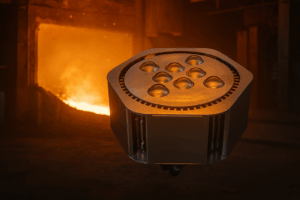
2.1 High Heat Environments
High-temperature industrial environments demand more than just bright lights—they demand fixtures engineered for thermal survival.
Common examples include:
Heat is the enemy of most electronics, and LEDs are no exception. Excessive temperatures can cause:
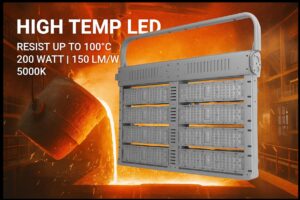
Lighting designed for these applications must integrate robust thermal management systems that allow reliable operation at 100°C, 150°C, or even 200°C ambient conditions.
2.2 Particulate-Rich Settings
Particulates are an equally formidable challenge, especially when combined with high heat.
Examples include:
Dust can infiltrate fixtures, clog cooling fins, degrade optical clarity, and cause overheating. In combustible dust environments, improperly sealed fixtures can even become ignition sources.
The key to dust resistance lies in sealed housings with high IP ratings and anti-static optical coatings that minimize dust adhesion.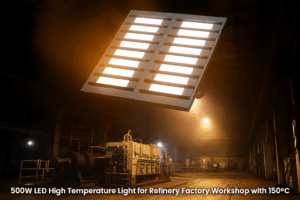
A durable LED fixture for these conditions must be more than an efficient light source—it is a system engineered to manage heat, repel dust, and withstand mechanical stress.
3.1 Thermal Management Systems
3.2 Dustproof & Sealed Housing
3.3 Electronics & Component Resilience
When evaluating LED fixtures for these environments, performance metrics matter.
Durable LEDs offer compelling advantages:
6.1 Metal & Glass Manufacturing
Fixtures rated for 150°C–200°C handle continuous thermal load near furnaces and kilns.
6.2 Mining & Quarrying
IP66–IP68 dustproof fixtures resist infiltration while enduring vibration from drilling and crushing.
6.3 Food & Agriculture
Dustproof LEDs with HACCP-compliant designs meet safety standards in grain elevators and flour mills.
6.4 Power Generation & Chemicals
Corrosion-resistant housings and high-temp drivers withstand chemical particulates and boiler heat.
Example 1 – High-Heat Steel Foundry
After switching to high-temp-rated LEDs, a facility reduced maintenance downtime by 40% and improved worker visibility.
Example 2 – Cement Manufacturing Plant
Two years after installation, IP67-rated LEDs retained over 95% of initial lumen output despite constant dust exposure.
Lighting for high heat and particulate-rich settings is a technical challenge—but modern durable LED fixtures prove it can be done with efficiency, reliability, and safety in mind. By combining advanced thermal management, precision sealing, and industrial-grade electronics, these lights deliver consistent performance where traditional fixtures fail.
Whether in a foundry, quarry, grain mill, or chemical plant, investing in purpose-built LEDs means fewer interruptions, lower costs, and safer, better-lit workspaces.
–The End–