Industrial facilities around the world face a persistent challenge: how to maintain reliable lighting systems in environments filled with corrosive chemicals, gases, and moisture. From chemical plants to poultry farms, and from wastewater treatment facilities to marine operations, conventional lighting fixtures often deteriorate prematurely due to exposure to corrosive agents. The result is not only high maintenance and replacement costs but also increased downtime and risks to safety.
To address these challenges, corrosion-proof LED lighting solutions have emerged as the industry standard for extreme environments. Built with advanced materials such as 316 stainless steel, reinforced tempered glass, specialized protective coatings, and IP69 ingress protection, these fixtures are specifically designed to withstand the toughest industrial conditions. More than just a durable product, corrosion-proof LED lights deliver consistent performance, high energy efficiency, and long service life, making them a vital investment for industries operating in aggressive settings.
This article explores the science behind corrosion, the engineering that enables LED lights to resist it, and the wide range of applications where corrosion-proof lighting delivers unmatched value.
Corrosion occurs when materials—especially metals—react with their environment, leading to deterioration of structural integrity and functionality. Industrial facilities often expose lighting fixtures to conditions that accelerate this process, such as high humidity, chemical vapors, and corrosive gases. Over time, untreated or inadequately protected lights can suffer from rusting, surface degradation, and complete failure.
Ammonia (NH₃):
Frequently found in poultry farms, fertilizer production facilities, and refrigeration systems.
Causes stress corrosion cracking and accelerates material fatigue in conventional metals.
Sulfur Dioxide (SO₂):
Generated by combustion processes, power plants, and certain industrial chemical reactions.
Reacts with moisture to form sulfurous acid, leading to aggressive corrosion of exposed surfaces.
Nitrogen Dioxide (NO₂):
A byproduct of industrial emissions, found in high concentrations near manufacturing and processing plants.
Contributes to metal oxidation and degradation of protective coatings.
Chlorine (Cl₂):
Common in water treatment plants, paper mills, and marine environments.
Extremely aggressive against metals, leading to pitting corrosion and surface breakdown.
When combined with moisture and elevated temperatures, these agents create some of the harshest operating environments for any lighting fixture. Standard lighting systems are often unable to survive for long in such conditions, leading to frequent breakdowns and increased costs.
The backbone of any corrosion-proof LED lighting solution is its material composition and design.
Compared to standard 304 stainless steel or aluminum housings, 316 stainless steel offers superior resistance to chemical attack and oxidation. Its high molybdenum content enhances its ability to resist chloride-induced corrosion, making it particularly effective in environments with chlorine or salt exposure.
Tempered glass provides both mechanical strength and chemical resistance. It prevents corrosive agents from directly contacting sensitive internal components, while also withstanding impact, pressure, and high-temperature variations.
Many conventional lights rely on aluminum housings, which, although lightweight, are susceptible to oxidation and degradation in chemically aggressive settings. Corrosion-proof LED fixtures eliminate aluminum components, instead relying on stainless steel and specialized coatings for long-term durability.
Even with robust base materials, additional surface protection is necessary in industries where corrosive vapors and chemical splashes are constant threats.
Specialized Protective Coatings act as a barrier between the fixture and the environment, preventing corrosive agents from penetrating and damaging the housing.
These coatings are engineered to withstand ammonia, chlorine, sulfur dioxide, and nitrogen dioxide, among others.
The result is extended lifespan, reduced need for frequent replacements, and minimized maintenance interruptions.
Unlike standard industrial coatings that may wear down under high-pressure cleaning or acidic exposure, advanced protective finishes are designed for maximum endurance in aggressive conditions.
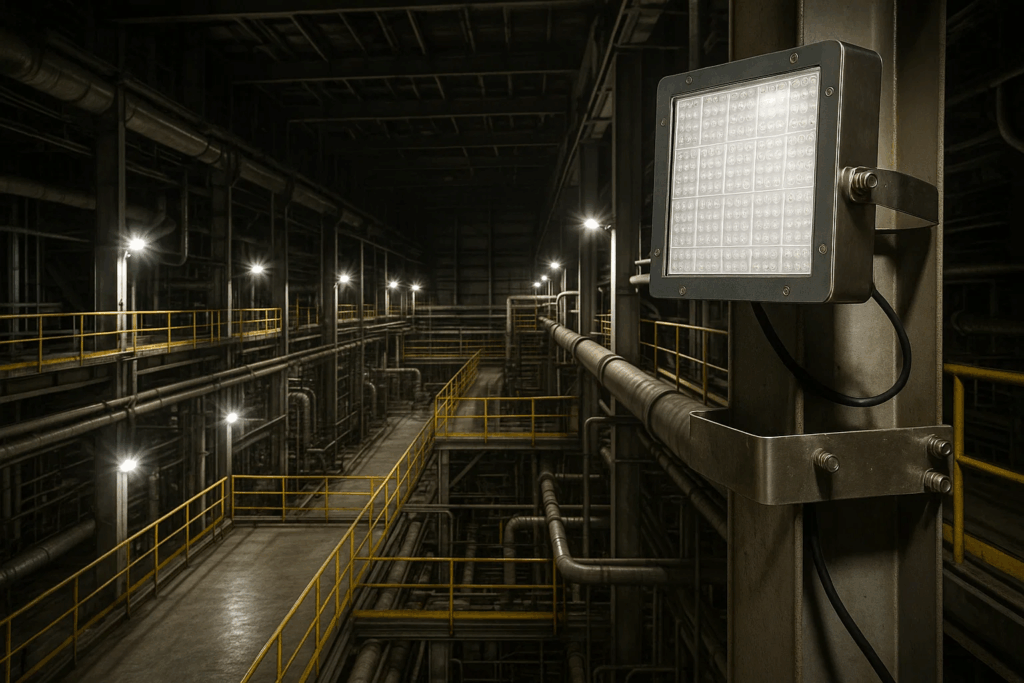
Ingress Protection (IP) ratings measure how effectively a fixture resists intrusion from solids and liquids. Corrosion-proof LED flood lights typically achieve IP69, the highest level of protection available.
This rating ensures that fixtures are:
Completely dust-tight, preventing fine particles from entering.
Fully resistant to high-pressure and high-temperature water jets, making them ideal for facilities requiring intensive washdowns.
Protected against corrosive gases, ensuring that even airborne chemical agents cannot compromise internal electronics.
Such sealing not only enhances durability but also reduces safety risks in sensitive environments where contamination must be minimized.
Corrosive gases and chemicals are not the only challenges industrial lights face—high temperatures and enclosed spaces also contribute to fixture degradation. Without proper heat dissipation, even the most corrosion-resistant materials may fail prematurely.
Corrosion-proof LED flood lights incorporate advanced thermal management systems, which:
Prevent overheating by efficiently dispersing heat away from internal components.
Protect sensitive electronics from thermal stress.
Ensure stable performance in environments where ambient temperatures fluctuate or remain consistently high.
This combination of corrosion resistance and thermal reliability results in lighting systems that operate continuously and efficiently without risk of failure.
The versatility of corrosion-proof LED lights makes them suitable for a wide variety of industries:
Poultry and Livestock Farms:
Constant exposure to ammonia-rich environments.
Lighting must withstand corrosive vapors while remaining safe and efficient.
Chemical Processing Plants:
Presence of multiple corrosive gases and chemical splashes.
Fixtures must endure aggressive exposure without degrading.
Water and Wastewater Treatment Facilities:
High chlorine levels and continuous moisture.
Need for sealed, corrosion-resistant lighting to ensure safety and compliance.
Marine Operations:
Salt spray, chlorine, and high humidity.
Stainless steel and protective coatings provide resilience against salt-induced corrosion.
Surface Treatment and Plating Facilities:
Acidic vapors and extreme chemical conditions.
Requires specialized fixtures that won’t degrade under exposure to aggressive agents.
In each of these industries, reliable lighting is not just about visibility—it directly contributes to safety, operational efficiency, and regulatory compliance.
Investing in corrosion-proof LED flood lights delivers multiple advantages:
Extended Lifespan: Advanced materials and protective designs reduce premature failures.
Lower Maintenance Costs: Reduced need for frequent replacements saves on labor and materials.
Consistent Performance: Reliable illumination even in the harshest environments.
Energy Efficiency: High-performance LED technology reduces energy consumption.
Improved Safety: Eliminates risks associated with failed or degraded lighting in critical areas.
Ultimately, these lights provide operators with peace of mind, knowing that their systems can withstand aggressive industrial conditions while maintaining efficiency and performance.
Lighting is often one of the most overlooked components in industrial facility design, yet it plays a crucial role in safety, efficiency, and productivity. In corrosive environments, the choice of lighting can mean the difference between continuous reliable operation and frequent costly interruptions.
Corrosion-proof LED lights represent the pinnacle of engineering for extreme environments. By combining 316 stainless steel construction, tempered glass surfaces, advanced protective coatings, IP69 ingress protection, and superior thermal management, these fixtures deliver unparalleled durability and performance.
For industries operating in harsh and chemically aggressive environments, corrosion-proof LED lighting is not just a choice—it is a necessity. By ensuring consistent illumination, minimizing maintenance costs, and extending fixture lifespan, these solutions provide long-term value and reliability where it matters most.