
Lighting design for high-temperature industrial environments presents challenges that go far beyond conventional commercial or warehouse applications. Facilities such as metal foundries, steel mills, glass factories, ceramic kilns, and power generation plants operate under extreme thermal stress, airborne contaminants, vibration, and extended operating hours. In these conditions, lighting is not merely a supporting utility but a critical component of operational safety, efficiency, and productivity.
Selecting the correct LED wattage is therefore a strategic technical decision. Insufficient wattage can lead to inadequate illumination, increasing the risk of accidents, reducing visual comfort, and negatively affecting task accuracy. Conversely, excessive wattage often results in wasted energy, glare, higher operating temperatures within the luminaire, and accelerated component degradation. Both extremes undermine the reliability and economic benefits that LED technology is intended to deliver.
This article provides a comprehensive technical and application-focused guide to selecting high-temperature LED solutions ranging from 50W to 400W. It explains how wattage interacts with thermal design, mounting height, optical distribution, and environmental severity, offering practical insight for engineers, contractors, and facility managers seeking reliable long-term lighting performance in extreme heat conditions.
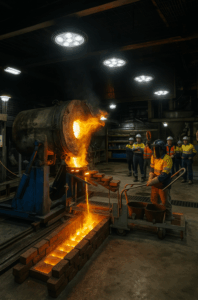
High-temperature LED lighting refers to luminaires engineered to operate safely and consistently in ambient temperatures well above the limits of standard LED fixtures. While typical industrial LEDs are rated for environments up to 40–50°C, high-temperature solutions are designed for continuous operation at 60°C, 90°C, 150°C, or even 200°C, depending on configuration.
Achieving such performance requires a system-level thermal design. High-temperature LED fixtures use reinforced heat sinks with optimized surface area, high-conductivity aluminum alloys, and carefully engineered airflow paths to dissipate heat efficiently. Equally important are the electronic components: drivers must use high-temperature capacitors, industrial-grade ICs, and protective circuitry to maintain electrical stability under prolonged thermal exposure. In many designs, drivers are isolated, shielded, or remotely mounted to reduce thermal stress.
Optical materials and seals must also withstand repeated thermal expansion and contraction without cracking, yellowing, or losing ingress protection. As wattage increases, internal heat generation rises proportionally, making the relationship between wattage and thermal capacity a defining factor in fixture selection. Understanding this interaction is fundamental to choosing the correct wattage for high-temperature applications.
Installation Height
Mounting height directly influences the wattage required to achieve target illuminance levels. Low-mounted fixtures require relatively modest wattage, while high-bay and ultra-high-bay installations demand greater lumen output to compensate for distance and light dispersion. In heavy industrial facilities, mounting heights often exceed 10 meters and can reach 20 meters or more, making wattage selection inseparable from structural layout.
Required Illuminance (Lux Levels)
Different tasks require different lighting intensities. General industrial areas may function adequately at 100–200 lux, whereas inspection stations, assembly lines, and safety-critical zones often require 300–500 lux or higher. Wattage must be selected based on the required lux at the working plane, not on nominal power ratings alone.
Environmental Conditions
Ambient temperature, radiant heat, dust, corrosive fumes, and vibration all affect how much wattage a fixture can safely and efficiently handle. In extremely hot zones, luminaires may need to operate with thermal derating. Selecting an appropriate wattage ensures stable output without exceeding thermal limits.
Beam Angle and Optical Design
Optical efficiency plays a decisive role in determining effective illumination. Narrow beam optics concentrate light for high mounting heights, reducing the need for excessive wattage, while wide beam optics provide uniform coverage at lower heights but may require higher wattage to achieve the same lux levels.
Energy Efficiency and Operating Cost
Optimized wattage selection reduces energy consumption, lowers heat generation, and extends luminaire lifespan. Over years of continuous operation, proper wattage selection significantly reduces total cost of ownership.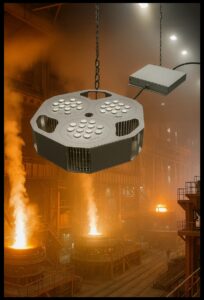
50W–80W High-Temperature LED Solutions
Fixtures in this wattage range are primarily used for localized lighting in high-temperature environments. Typical applications include walkways, access platforms, control areas adjacent to hot zones, and maintenance corridors. Their compact size and lower heat generation make them suitable where space is limited or where excessive brightness is unnecessary.
While highly energy-efficient, these fixtures are not intended for high-bay or large-area illumination. Their correct use lies in supplementing larger systems or addressing specific task areas without adding unnecessary thermal load.
100W–150W High-Temperature LED Solutions
The 100W–150W range represents one of the most widely used categories in industrial high-temperature lighting. These fixtures are suitable for mounting heights between 6 and 10 meters and commonly replace traditional 250W–400W metal halide lamps. They provide a strong balance between light output, efficiency, and manageable thermal stress.
Applications include production halls, heat-treatment areas, and manufacturing lines where consistent, uniform illumination is required without excessive glare.
200W–250W High-Temperature LED Solutions
This wattage range is designed for more demanding environments and higher ceilings, typically between 10 and 15 meters. These fixtures deliver high lumen output and are used in steel plants, glass factories, and heavy manufacturing zones.
Advanced thermal management is critical at this level. High-quality designs ensure stable operation even when ambient temperatures approach the upper limits of the fixture’s rating.
300W–400W High-Temperature LED Solutions
The highest wattage category is reserved for extreme applications with very high mounting heights or large open industrial spaces. These fixtures often replace multiple HID luminaires, providing improved uniformity and reduced maintenance.
Typical applications include large foundry halls, furnace zones, power plants, and outdoor installations exposed to intense heat. When correctly specified, these high-wattage LEDs deliver long-term reliability despite their demanding operating conditions.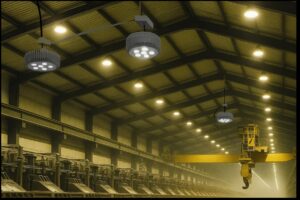
In high-temperature industrial environments, the limitations of traditional lighting technologies become especially apparent. Metal halide and high-pressure sodium lamps have long been used in such settings, but their performance degrades rapidly under extreme heat. Elevated ambient temperatures accelerate lumen depreciation, shorten lamp life, and increase the likelihood of sudden failures. Restart delays after power interruptions further compromise safety and productivity.
High-temperature LED lighting fundamentally changes this performance profile. LEDs deliver instant full brightness, even after power interruptions, which is critical in hazardous industrial zones. Unlike discharge lamps, LEDs maintain more stable lumen output over time, provided that thermal conditions are properly managed. This stability translates into consistent visibility and improved working conditions.
From an energy perspective, LEDs offer significantly higher efficacy, allowing lower wattage systems to replace higher-power traditional lamps while delivering equal or superior illuminance. Maintenance requirements are also drastically reduced. In high-temperature environments where access is difficult, expensive, or dangerous, extended service life is a major operational advantage.
Additionally, LEDs generate directional light, minimizing wasted illumination and improving optical control. This allows for more precise lighting design, reducing glare and improving uniformity. When evaluated over the full lifecycle—including energy consumption, maintenance, downtime, and safety—high-temperature LED solutions provide a clear technical and economic advantage over traditional lighting systems.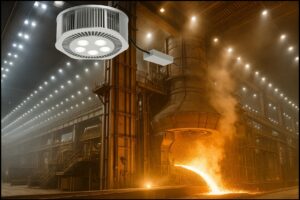
One of the most common mistakes in industrial lighting projects is selecting wattage based on habit rather than analysis. Engineers and specifiers often oversize fixtures as a precaution, assuming that higher wattage automatically ensures better performance. In high-temperature environments, this approach can be counterproductive. Excessive wattage increases internal heat generation, pushing fixtures closer to their thermal limits and potentially reducing lifespan.
Another frequent error is neglecting ambient temperature data. Many installations fail prematurely because fixtures are specified based on nominal ratings without accounting for sustained high ambient or radiant heat. This oversight can lead to thermal derating, reduced lumen output, or even driver failure.
Focusing exclusively on wattage instead of effective lumen delivery is another pitfall. Two fixtures with identical wattage can produce vastly different results depending on optical efficiency, beam angle, and mounting height. Without considering these variables, lighting performance may fall short despite high power consumption.
Finally, insufficient use of lighting simulations and professional assessments often leads to uneven illumination, dark zones, or excessive overlap. A disciplined, data-driven approach to wattage selection is essential to avoid these costly mistakes.
In real-world applications, wattage selection should follow a structured evaluation process rather than relying on generic rules of thumb. The first step is to clearly define the application: task type, required illuminance, operating hours, and environmental severity. Mounting height and spacing then determine the approximate lumen output needed per fixture.
For low mounting heights or localized tasks, lower wattage fixtures often provide sufficient illumination with better efficiency and lower thermal stress. As mounting height increases, wattage must increase accordingly, but only to the extent required to achieve target lux levels at the working plane.
Lighting simulations play a crucial role in this process. Photometric analysis allows designers to visualize light distribution, identify potential glare or shadowing issues, and fine-tune wattage and optics before installation. This reduces the risk of over- or under-lighting and ensures optimal system performance.
In high-temperature environments, it is also advisable to include a thermal safety margin by selecting fixtures rated above the expected ambient temperature. Wattage should be matched to this rating to avoid operating at the edge of thermal capability. When properly applied, this method results in a lighting system that is efficient, reliable, and economically optimized over its full service life.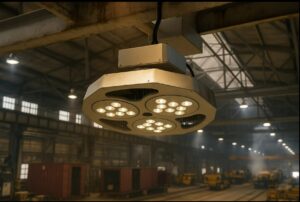
High-temperature industrial projects rarely conform to standard lighting templates. Each facility presents unique challenges related to layout, heat sources, operating cycles, and safety requirements. As a result, customization plays a critical role in effective wattage selection and system design.
Many high-temperature LED fixtures offer adjustable wattage options, allowing output to be fine-tuned during commissioning or adapted to future changes. Interchangeable optics enable designers to modify beam angles without changing fixture wattage, optimizing light distribution for specific mounting heights or layouts.
Thermal customization is equally important. Fixtures may be specified with different thermal resistance levels—such as 90°C, 150°C, or 200°C—to match the exact conditions of the installation site. Remote driver configurations further enhance reliability by isolating sensitive electronics from extreme heat zones.
For complex projects, professional lighting design services and on-site assessments provide invaluable insight. Custom solutions not only improve performance and reliability but also maximize return on investment by ensuring that wattage, optics, and thermal design are precisely aligned with real operating conditions.
Choosing the right wattage for high-temperature LED lighting between 50W and 400W is a critical engineering decision with long-term implications. Correct wattage selection ensures safe working conditions, stable illumination, energy efficiency, and extended system lifespan, even in the most extreme industrial environments.
By understanding thermal limitations, application requirements, and optical performance, and by avoiding common selection mistakes, industrial users can fully realize the advantages of high-temperature LED technology. When properly specified and customized, these lighting systems deliver reliable performance and measurable economic benefits over their entire lifecycle.
–The End–