
High-temperature LED lighting has become an essential technology across industrial and professional cinematic applications. In industries such as steel manufacturing, glass production, and ceramic kilns, lighting fixtures are exposed to ambient temperatures that can easily exceed 90°C. Similarly, in cinematography, particularly for underwater shoots or outdoor desert scenes, high-power LED fixtures are often required to operate continuously under extreme thermal stress. While LEDs offer advantages such as high energy efficiency, compact size, and precise optical control, their performance and longevity are highly sensitive to temperature.
Excessive heat is one of the primary factors limiting LED efficiency and lifespan. Unlike incandescent or fluorescent lamps, which can tolerate higher temperatures without significant efficiency loss, LEDs require careful thermal design to maintain stable light output, color fidelity, and device integrity. Failure to address thermal management can lead to lumen depreciation, color shift, and even catastrophic device failure, posing operational and safety risks.
This article explores advanced thermal management strategies for high-temperature LED lighting, including materials, heat sink engineering, active and hybrid cooling, computational modeling, and emerging technologies. We also present real-world examples of industrial and cinematic applications, demonstrating how design choices and thermal solutions ensure reliable performance in harsh conditions.
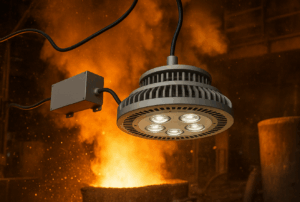
Understanding the mechanisms of heat generation in LEDs is critical for designing effective thermal management systems. LEDs convert electrical energy into light through electroluminescence, but the conversion is not perfectly efficient. Typically, 20–40% of the electrical energy is dissipated as heat, depending on the LED type, power level, and operating conditions.
The primary source of heat is the LED junction, where electrons recombine with holes to produce photons. This process inherently generates heat, and the temperature of the junction (Tj) is a key parameter that determines efficiency, color stability, and lifespan. High junction temperatures accelerate phosphor degradation and reduce luminous efficacy, causing visible brightness loss and color shift over time.
Beyond the LED chip itself, the driver electronics that regulate current and voltage generate additional heat. In high-wattage industrial fixtures or cinematic arrays, the power supply can produce heat comparable to the LEDs, necessitating careful separation or integration with thermal pathways.
Finally, environmental factors play a crucial role. LEDs installed near furnaces, kilns, or in outdoor areas with direct sun exposure experience additional ambient heat. Designers must account for cumulative thermal loads, as the combined heat from internal sources and surroundings determines the maximum safe operating temperature.
Excessive heat in LED systems leads to several interrelated issues. Firstly, lumen output diminishes as Tj rises. A typical high-power LED may lose 10–20% of its brightness when operated above recommended junction temperatures. Secondly, high temperatures can alter the spectral output, reducing CRI and TLCI, which are critical for industrial inspection accuracy or cinematic color fidelity. Thirdly, prolonged thermal stress accelerates solder joint fatigue, PCB delamination, and phosphor breakdown, all of which can result in premature fixture failure.
In extreme cases, unmanaged heat can compromise safety. Industrial LEDs placed near flammable materials or within confined enclosures must maintain controlled operating temperatures to avoid fire hazards or electrical failures.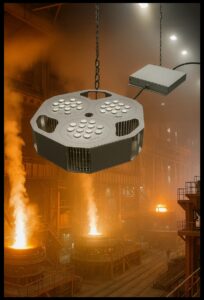
Thermal management for high-temperature LEDs involves both passive and active solutions. Each method is designed to efficiently transfer heat away from the LED junction while maintaining fixture integrity and operational stability.
The selection of materials with high thermal conductivity is foundational. Aluminum PCBs are widely used in high-power LEDs due to their ability to rapidly conduct heat away from the chip, with thermal conductivity around 200 W/m·K. For even more demanding conditions, ceramic substrates such as aluminum oxide (Al₂O₃) or aluminum nitride (AlN) provide superior thermal stability and resist thermal expansion, reducing mechanical stress in high-temperature environments.
Thermal Interface Materials (TIMs) such as silicone pads, graphite sheets, or phase-change materials are applied between LEDs and heat sinks to minimize thermal resistance. Choosing the appropriate TIM ensures consistent heat transfer, reducing junction temperature and preventing localized overheating, which is especially critical in densely packed arrays.
Heat sinks are essential for conducting heat away from LEDs and into the surrounding environment. Traditional finned heat sinks increase surface area for natural convection, but spacing and orientation must be optimized to allow airflow, particularly in high-temperature enclosures where convection is limited.
For more advanced applications, vapor chambers distribute heat evenly across the base of the LED module, eliminating hotspots and enhancing thermal uniformity. Microchannel heat exchangers, often used in high-wattage industrial or underwater fixtures, employ liquid or air channels embedded in the heat sink to dramatically increase thermal transfer, allowing LEDs to operate safely under extreme thermal loads.
Proper heat sink design not only controls temperature but also impacts fixture size, weight, and reliability, especially in portable or aerial lighting applications.
Active cooling involves the use of fans, pumps, or fluid circulation to augment passive heat dissipation. In industrial environments with sufficient space, forced air cooling can significantly lower junction temperature. However, fans introduce mechanical complexity and potential maintenance challenges in dusty or corrosive environments.
Liquid cooling is increasingly adopted in high-power LED arrays for cinematic and industrial applications. Closed-loop systems with water or dielectric fluids efficiently remove heat even from compact or enclosed fixtures. Hybrid cooling systems, combining passive heat sinks with active fluid or air circulation, provide redundancy and adaptability, ensuring stable operation even if one component fails.
Beyond heat sinks, the fixture housing itself can contribute to thermal management. Thermal-resistant coatings reflect ambient heat and reduce heat absorption, protecting internal components. Heat-dissipating enclosures made of metals with high conductivity or vented panels enhance both conduction and convection. Sensitive electronics can also be thermally insulated from the main heat sources, allowing the LEDs to operate at high power without compromising driver longevity or performance.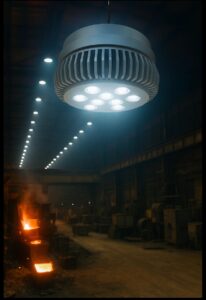
Designing high-temperature LED fixtures without predictive modeling is risky and often inefficient. Thermal simulation allows engineers to anticipate problems and optimize fixture design before production.
Simulation identifies hotspots, thermal gradients, and potential areas of mechanical stress. Predicting these factors in advance prevents over-engineering and reduces production costs while ensuring reliability.
Computational Fluid Dynamics (CFD) models airflow and heat transfer, essential for fixtures using forced convection or hybrid cooling. CFD can reveal stagnation zones where air circulation is insufficient and suggest modifications to fin spacing, enclosure venting, or fan placement.
Finite Element Analysis (FEA) simulates conduction and thermal expansion within the LED, PCB, heat sink, and housing. FEA helps engineers understand how differential thermal expansion may stress solder joints or phosphor layers, enabling them to select appropriate materials and tolerances.
Simulation informs the optimal placement of high-power LEDs to avoid localized overheating. Engineers can fine-tune TIM thickness, heat sink geometry, and housing design to maximize thermal efficiency. For high-temperature industrial applications, even minor improvements in heat distribution can extend fixture life by thousands of operational hours.
In steel foundries and glass production facilities, ambient temperatures can exceed 100°C, and radiant heat from furnaces adds significant thermal load. LED fixtures for these environments must withstand continuous operation without degrading light output or color quality.
Solution: Engineers use aluminum-ceramic hybrid PCBs with vapor chamber heat sinks and protective housings coated with reflective thermal paint. Phase-change TIMs ensure effective junction cooling. The result is a reliable fixture that maintains lumen output and color fidelity even at 120°C ambient temperatures, with projected lifespans exceeding 50,000 hours.
Outdoor desert filming and underwater cinematography require high-output, compact LED arrays capable of operating continuously under extreme thermal conditions. Traditional passive cooling is often insufficient due to limited airflow or immersion in water.
Solution: Liquid-cooled LED arrays with sealed housings and thermally isolated driver electronics maintain stable junction temperatures. Real-time temperature monitoring allows adaptive cooling, preventing heat-induced color shift or flicker. These systems ensure consistent cinematic quality while protecting sensitive components from environmental hazards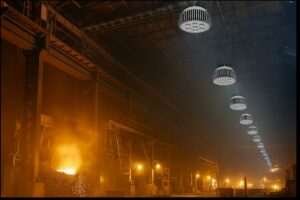
PCMs absorb transient heat spikes, temporarily storing energy as they change phase. This mitigates short-term thermal stress during rapid intensity changes, particularly in high-power cinematic LEDs or industrial lighting with intermittent peaks.
Graphene-enhanced heat sinks and carbon-based composites provide ultra-high thermal conductivity while minimizing weight. These materials are particularly useful in aerial or portable lighting systems where fixture mass is a concern, offering improved heat dissipation without increasing size.
Next-generation LED systems integrate sensors and adaptive control mechanisms. Junction temperature sensors provide real-time feedback, enabling fans or liquid pumps to adjust flow rates dynamically. Predictive analytics can forecast thermal failure, allowing proactive maintenance and reducing operational downtime in industrial or cinematic workflows.
Effective thermal management in high-temperature LED lighting requires an integrated approach:
High-temperature LED lighting demands careful thermal management to maintain efficiency, color fidelity, and long operational life. Combining high-conductivity materials, advanced heat sink designs, active and hybrid cooling, and simulation-driven engineering allows designers to meet the challenges of extreme environments. Emerging materials like graphene, phase-change compounds, and AI-controlled thermal systems promise further improvements in performance and reliability.
As industrial and cinematic applications continue to push thermal limits, the integration of intelligent thermal design and predictive maintenance will become the standard, ensuring high-performance LEDs remain a viable solution even in the harshest conditions.
–The End–