
Extreme thermal environments represent one of the most challenging operating conditions for lighting systems. Conventional luminaires are typically engineered for ambient temperatures below 50 °C and rely on moderate airflow to dissipate internally generated heat. When deployed in environments such as metallurgical plants, kiln facilities, or high-temperature processing lines, these standard fixtures experience accelerated lumen depreciation, electronic driver failure, insulation breakdown, and mechanical deformation. Such failures are not merely inconvenient—they can lead to production downtime, safety hazards, and costly maintenance cycles that affect operational continuity and worker safety.
High-temperature LED luminaires are purpose-built to withstand elevated ambient temperatures while maintaining optical output stability, electrical safety, and structural integrity. Their design philosophy combines thermal-resilient electronic components, optimized heat conduction pathways, and robust enclosure engineering. However, even advanced luminaires cannot compensate for poor installation planning. Environmental misjudgment, improper mounting orientation, or incompatible cabling can undermine performance. Therefore, successful deployment requires a holistic engineering methodology integrating environmental assessment, electrical infrastructure analysis, mechanical design considerations, and long-term maintenance planning.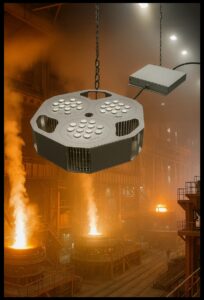
Extreme heat zones are categorized according to sustained ambient temperature ranges and exposure profiles. Moderate high-heat environments (60–90 °C) are typically found near drying systems or process exhaust outlets. Industrial high-heat zones (90–150 °C) exist in steel fabrication lines, ceramic firing plants, and heavy industrial production floors. Ultra-extreme environments exceeding 150 °C occur near furnace doors, molten metal transfer points, and thermal reactors.
These distinctions determine material requirements and electronic tolerances. LED junction temperature limits, capacitor electrolyte stability, seal elasticity, and optical polymer resistance all vary with temperature. Engineers must therefore select luminaires with ratings that match measured conditions rather than estimated values. A mismatch between fixture rating and environment classification is one of the most common causes of premature lighting failure in industrial facilities.
Extreme heat lighting systems are widely required across industries where thermal processes are integral to production. Foundries and smelting plants generate intense radiant heat from molten metals. Glass manufacturing lines expose fixtures to infrared radiation capable of raising surface temperatures far above ambient readings. Steel mills combine heat with vibration and airborne particulate contamination. Industrial baking or curing facilities add humidity and grease vapor to the thermal load.
Each environment imposes a distinct combination of stressors: thermal, mechanical, chemical, and electrical. Effective lighting system design must evaluate these conditions collectively. Ignoring secondary environmental factors—such as corrosive gases or vibration—can compromise even high-temperature-rated fixtures.
High-temperature luminaires incorporate specialized drivers using heat-resistant capacitors and semiconductors capable of operating at elevated junction temperatures without significant efficiency loss. Their thermal management systems include precision-machined heat sinks and high-conductivity substrates that rapidly transfer heat away from sensitive electronic components.
Housing structures are typically constructed from anodized aluminum, stainless steel, or ceramic composites to prevent deformation and oxidation. Internal wiring insulation often uses silicone rubber or PTFE to maintain dielectric strength at temperatures exceeding standard insulation limits. High ingress protection ratings shield internal components from dust, steam, and corrosive vapors. These integrated features enable stable operation in environments that would quickly destroy conventional lighting systems.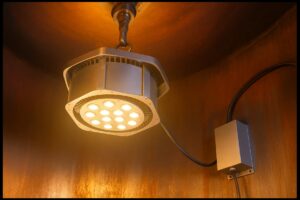
Accurate environmental measurement is the foundation of any high-temperature installation. Engineers must evaluate ambient air temperature, radiant heat intensity, and localized hot spots. Infrared thermal imaging is especially useful for detecting uneven heat distribution across ceilings or structural beams. Facilities with cyclical thermal processes require monitoring over complete production cycles to capture peak values.
Thermal mapping data informs fixture selection, mounting distance, and shielding requirements. Without such analysis, installers risk placing luminaires in zones where actual temperatures exceed rated limits, even if average readings appear acceptable.
Electrical systems behave differently at elevated temperatures. Conductors exhibit increased resistance, potentially causing voltage drops and reduced driver efficiency. Insulation may soften or degrade, increasing the likelihood of short circuits or ground faults. Therefore, all wiring, connectors, and junction boxes must be verified for high-temperature ratings.
Industrial facilities frequently generate electrical transients from heavy machinery. These surges can accelerate component aging in hot environments. Integrating surge protection and ensuring stable grounding systems significantly improves lighting reliability.
Mounting position influences both thermal exposure and lighting performance. Fixtures should be located away from direct radiant heat whenever possible while still achieving required illuminance levels. Airflow pathways must remain unobstructed to allow natural convection cooling. Maintenance accessibility is equally critical. Installing fixtures in inaccessible high-temperature zones may save installation time initially but will increase long-term servicing costs and operational disruption.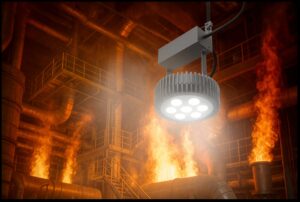
Correct positioning minimizes thermal stress while maximizing illumination uniformity. Maintaining clearance from furnaces, exhaust ducts, and heated surfaces prevents excessive radiant loading. Beam angles should be selected to avoid direct exposure of optical components to heat sources. Even slight positional adjustments can reduce thermal load significantly without affecting light distribution.
Mounting assemblies must match environmental demands. Standard brackets may weaken at high temperatures, while untreated fasteners can oxidize. Stainless steel hardware, heat-resistant alloys, and vibration-damping mounts ensure structural integrity. Facilities with heavy equipment benefit from anti-vibration hardware that prevents mechanical fatigue.
Proper cable routing protects electrical integrity. Conductors should be enclosed in heat-resistant conduits and routed away from hot pipes or radiant surfaces. Thermal expansion must be accommodated through slack loops or flexible connectors. Failure to account for expansion can cause insulation cracking or connector loosening, leading to electrical faults.
Installation configuration directly affects heat dissipation. Passive cooling relies on natural convection, so heat sink orientation must allow warm air to rise freely. Incorrect orientation can trap heat and raise internal temperatures. Reflective shields can deflect radiant heat, while insulated mounting plates reduce conductive transfer from hot structures. In extremely hot zones, auxiliary ventilation systems may be required to maintain safe operating temperatures.
High-temperature lighting must comply with electrical and industrial safety standards such as UL, CE, or IEC requirements. Hazardous environments may require explosion-proof certifications. Certified fixtures undergo rigorous testing for thermal endurance, dielectric strength, and mechanical durability. Compliance ensures both operational safety and regulatory acceptance, reducing liability risks for facility operators.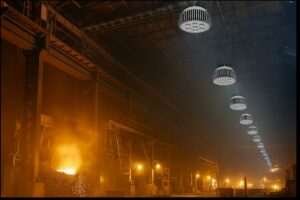
Routine inspection schedules must be significantly more rigorous in high-temperature environments than in standard industrial settings. Elevated temperatures accelerate chemical reactions, material aging, and electronic degradation, meaning that components which might last several years under normal conditions could exhibit early wear when exposed to sustained heat. Inspection intervals should therefore be determined based on both temperature intensity and operational duty cycles rather than fixed calendar periods. Facilities operating continuously at temperatures above 120 °C often benefit from quarterly inspections, while moderate heat zones may allow semiannual checks.
During inspections, technicians should evaluate multiple performance indicators simultaneously. These include luminous output stability, driver casing temperature, seal elasticity, wiring insulation condition, and mounting hardware integrity. Even minor deviations from baseline measurements can indicate underlying thermal stress. Establishing documented inspection protocols with standardized measurement methods allows maintenance teams to track performance trends over time. Such trend analysis is essential because many heat-related failures occur gradually rather than suddenly. Predictive maintenance based on inspection data can therefore prevent catastrophic lighting outages and reduce unplanned downtime.
In high-temperature industrial environments, airborne contaminants accumulate rapidly on luminaire surfaces. Dust, metal particles, oil vapor, and chemical residues can form insulating layers on heat sinks, severely reducing their ability to dissipate heat. Optical lenses may also become coated with residues that scatter light and reduce illumination efficiency. Consequently, cleaning is not merely an aesthetic task but a thermal management requirement.
Effective cleaning schedules should be tailored to environmental contamination levels. Facilities such as foundries or cement plants may require monthly cleaning, whereas controlled manufacturing environments might only need quarterly maintenance. Cleaning methods must be selected carefully to avoid damaging seals or coatings. Non-abrasive wipes, compressed air, or approved solvents are typically recommended. Importantly, cleaning procedures should be performed only after fixtures have cooled to safe handling temperatures, and power should be disconnected to prevent electrical hazards. Documented cleaning logs provide valuable data for correlating contamination levels with performance degradation, enabling optimization of maintenance intervals.
Identifying early indicators of heat-induced deterioration is crucial for preventing sudden luminaire failure. Thermal degradation often manifests subtly before functional breakdown occurs. One of the first visible signs is discoloration or yellowing of optical lenses, caused by prolonged exposure to elevated temperatures and ultraviolet radiation. Another common indicator is hardening or cracking of sealing gaskets, which compromises ingress protection and allows dust or moisture to penetrate the enclosure.
Electronic components may also exhibit symptoms. Drivers operating near their thermal limits may produce audible noise, fluctuating output, or intermittent shutdowns due to internal protection circuits. Heat sinks that become excessively hot to the touch relative to baseline measurements can signal restricted airflow or internal thermal resistance issues. Maintenance personnel should be trained to recognize these early warning signs and document them systematically. Prompt corrective action—such as repositioning fixtures, improving ventilation, or replacing degraded components—can extend system life significantly and prevent costly emergency replacements.
Unlike mechanical structures, electronic components and elastomer seals have finite service lives that shorten as operating temperature rises. High-temperature LED drivers typically contain capacitors and semiconductors whose longevity follows Arrhenius-type thermal aging behavior, meaning that every 10 °C increase in temperature can roughly halve expected lifespan. Therefore, replacement intervals should be calculated using manufacturer lifetime curves adjusted for actual operating conditions rather than nominal ratings.
Seals and gaskets require equal attention. Even high-temperature silicone materials gradually lose elasticity when exposed to continuous heat. Once a seal becomes rigid, it can no longer maintain a tight enclosure, allowing contaminants to enter and accelerate internal corrosion. Proactive replacement schedules—often every two to four years depending on temperature exposure—are far more economical than waiting for failure. Facilities implementing planned component replacement strategies benefit from predictable maintenance costs, improved reliability, and reduced risk of production interruption caused by lighting system malfunction.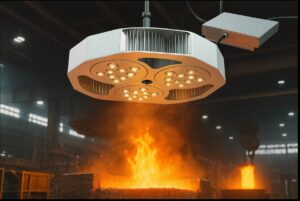
One of the most frequent and costly mistakes is installing standard industrial LED fixtures in environments that exceed their rated operating temperature. While these fixtures may initially function, prolonged exposure to excessive heat rapidly degrades internal components. Capacitors dry out, solder joints weaken, and LED junction temperatures rise beyond safe limits, causing lumen depreciation and eventual failure. Because such degradation occurs internally, the fixture may appear operational until sudden failure occurs without warning.
The decision to use standard fixtures is often driven by cost considerations or lack of awareness regarding environmental conditions. However, the apparent savings are illusory. Premature failure leads to repeated replacements, increased labor costs, and production disruptions. Additionally, overheating fixtures can pose fire or electrical hazards. Selecting luminaires specifically engineered for high-temperature operation is therefore not a luxury but a necessity for reliability and safety. Engineering specifications should always prioritize environmental compatibility over initial purchase price.
Manufacturers provide thermal derating curves that specify how performance and allowable load change with temperature. Ignoring these curves is a critical installation error. Even fixtures rated for high temperatures may require reduced power input or increased spacing when ambient conditions approach their upper limits. Operating a luminaire continuously at its maximum rated temperature without considering derating factors can drastically shorten lifespan.
Thermal derating data is derived from laboratory testing and represents safe operating boundaries. Engineers should analyze these curves during the design phase and incorporate safety margins. For example, if a fixture is rated for 150 °C but derating begins at 130 °C, installations in environments above 130 °C should consider lower drive currents, enhanced ventilation, or higher-rated models. Understanding and applying derating principles ensures that luminaires operate within optimal thermal envelopes rather than at the edge of failure thresholds.
Improper proximity to heat sources is another widespread installation mistake. Radiant heat intensity decreases exponentially with distance, meaning that even small increases in separation can significantly reduce thermal load on a fixture. Installers who position luminaires directly above furnaces, kilns, or exhaust outlets expose them to unnecessary stress that could be avoided through minor repositioning.
In addition to radiant heat, hot air plumes rising from equipment can create localized temperature spikes. Fixtures installed within these plumes may experience temperatures far exceeding measured ambient levels. Proper installation requires thermal mapping and airflow analysis to identify such zones. Using adjustable mounting brackets or extension arms allows fixtures to be positioned outside high-intensity heat paths while still delivering adequate illumination. Careful placement extends service life, improves reliability, and reduces maintenance frequency.
Electrical cabling is often overlooked during high-temperature lighting installations, yet it is one of the most vulnerable system components. Standard PVC-insulated wires soften and degrade at elevated temperatures, leading to insulation cracks, exposed conductors, and potential short circuits. When cables fail, they can disable entire lighting circuits and create serious safety hazards.
Selecting cables with insulation materials specifically rated for high temperatures—such as silicone rubber, fiberglass braid, or PTFE—is essential. These materials maintain dielectric strength and flexibility even under prolonged heat exposure. In addition, connectors and junction boxes must match the temperature rating of the cables. Using high-temperature fixtures with standard wiring negates the benefits of advanced luminaire design. A fully compatible electrical system ensures consistent performance and prevents failures originating outside the fixture itself.
Airflow is a critical yet frequently neglected factor in thermal management. Many high-temperature luminaires rely on natural convection to dissipate heat. Installing them inside enclosed housings, recessed cavities, or tightly packed structural frameworks can restrict airflow and trap heat around the fixture. This raises internal temperatures beyond design limits even if ambient air temperature appears acceptable.
Airflow restrictions often arise unintentionally during retrofits or structural modifications. For example, adding protective covers or shields without ventilation openings may reduce mechanical risk but create thermal buildup. Proper installation planning must evaluate airflow pathways and ensure that heat can escape freely. Computational fluid dynamics analysis or smoke-flow testing can help visualize air movement patterns. Ensuring unobstructed airflow allows luminaires to operate within their intended thermal range and prevents gradual overheating that might otherwise go unnoticed until failure occurs.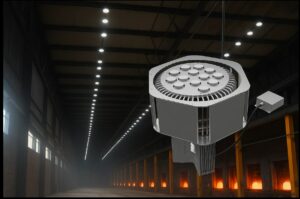
Initial purchase price is often the primary factor considered during lighting procurement, yet in high-temperature environments lifecycle cost is a far more meaningful metric. Lifecycle cost includes acquisition, installation, maintenance, energy consumption, replacement labor, and downtime expenses. High-temperature-rated luminaires may cost more upfront due to specialized materials and components, but they typically last significantly longer than standard fixtures under identical conditions.
A comprehensive lifecycle analysis frequently reveals that high-temperature fixtures deliver lower total cost of ownership. Reduced replacement frequency alone can offset the higher purchase price within a relatively short period. When maintenance labor and production downtime are included, the financial advantage becomes even more pronounced. Facilities that base purchasing decisions solely on initial price often incur higher long-term expenses due to repeated failures and service interruptions. Lifecycle cost evaluation provides a more accurate representation of economic value.
Return on investment for high-temperature LED systems is influenced by multiple factors including energy efficiency, reliability, and maintenance savings. LEDs inherently consume less power than traditional lighting technologies, and their efficiency advantage remains significant even at elevated temperatures. This translates into measurable reductions in electricity costs over time. Additionally, longer operational lifespans reduce the frequency of replacement purchases.
Reliability contributes strongly to ROI. In industrial environments, lighting failure can halt production or create unsafe working conditions requiring shutdowns. Avoiding such disruptions has substantial financial value that often exceeds energy savings. When ROI calculations incorporate both direct and indirect benefits, high-temperature LED installations typically demonstrate favorable payback periods. Facilities that implement these systems strategically often achieve full cost recovery within a few operational cycles.
Energy efficiency is particularly valuable in hot environments because excess heat from lighting contributes to overall thermal load. Inefficient luminaires convert more electrical energy into heat rather than light, increasing ambient temperature and placing additional strain on cooling systems. High-efficiency LED fixtures minimize this effect by producing more lumens per watt and less waste heat.
Reduced heat generation not only lowers energy consumption but also improves worker comfort and equipment longevity. In facilities with climate control systems, efficient lighting can decrease cooling demand, producing secondary energy savings. Even in non-conditioned spaces, lower heat output reduces localized temperature spikes. Thus, energy efficiency in high-temperature lighting is not solely about electricity cost; it also influences environmental stability and operational sustainability.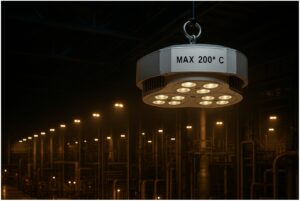
Unplanned downtime represents one of the most expensive consequences of lighting failure in industrial environments. When fixtures fail in extreme heat zones, replacement often requires shutting down production lines, cooling equipment, and deploying specialized maintenance personnel. These interruptions can result in lost output, delayed deliveries, and contractual penalties.
High-temperature LED systems reduce downtime risk by providing stable, long-lasting performance. Their robust design minimizes failure probability even under harsh conditions. Predictable maintenance schedules further enhance reliability by allowing replacements to be performed during planned shutdown periods rather than emergency situations. The financial value of avoiding downtime frequently surpasses the direct cost of lighting equipment. For many facilities, reliability is therefore the most compelling justification for investing in high-temperature-rated luminaires.
Advances in semiconductor materials and packaging continue to expand the operational limits of LED lighting. High-temperature-tolerant chip structures, improved phosphor stability, and advanced thermal interface materials are enabling luminaires to function reliably at temperatures once considered impractical. Smart monitoring technologies capable of real-time temperature and performance diagnostics are also becoming integrated into industrial lighting systems, enabling predictive maintenance and remote system management.
Installing LED lighting in extreme heat zones requires more than selecting a product labeled “high-temperature.” It demands a comprehensive engineering approach encompassing environmental analysis, electrical compatibility, mechanical integrity, thermal optimization, and disciplined maintenance planning. When these factors are addressed systematically, high-temperature LED systems deliver reliable illumination, improved safety, and reduced lifecycle costs even in the harshest industrial environments.
Properly engineered installations transform lighting from a consumable component into a durable infrastructure asset. By combining robust fixture design with meticulous installation practices and proactive maintenance strategies, facilities can ensure long-term performance stability, operational efficiency, and financial return.
–The End–