
In industrial environments, heat is not merely an operating condition—it is a constant adversary that directly determines the reliability, safety, and lifespan of lighting systems. From metal foundries and glass furnaces to ceramic kilns and industrial curing chambers, ambient temperatures can easily exceed the thermal tolerance of conventional luminaires. In such conditions, lighting failures are not occasional inconveniences; they are predictable outcomes of thermal stress acting on materials, electronics, and optical components.
Traditional lighting technologies, including standard LEDs designed for commercial or outdoor use, are fundamentally ill-equipped to survive prolonged exposure to high ambient temperatures. Their failure modes often include rapid lumen depreciation, driver breakdown, optical yellowing, and complete electrical failure. As industries demand higher uptime, lower maintenance costs, and improved energy efficiency, the limitations of conventional lighting become increasingly unacceptable.
High-temperature LED lighting represents a distinct category of engineering, not simply an incremental improvement over standard LED designs. These systems are purpose-built to operate reliably at ambient temperatures of 90°C, 150°C, or even 200°C, where ordinary luminaires would fail within days or weeks. This article explores the core technologies that make such performance possible, examining the thermal, electrical, optical, and mechanical innovations that enable LEDs to thrive where heat is unavoidable.
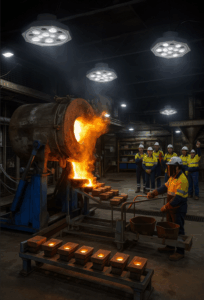
High-temperature environments are characterized not only by elevated ambient temperatures but also by complex thermal dynamics that challenge lighting systems in multiple ways. In industrial settings, heat may originate from furnaces, molten materials, high-power machinery, or enclosed processing chambers. Unlike outdoor heat exposure, which often fluctuates with weather conditions, industrial heat is typically continuous, localized, and intense.
A critical distinction must be made between ambient temperature and LED junction temperature. While ambient temperature refers to the surrounding air, junction temperature is the internal temperature of the LED semiconductor itself. In high-heat environments, the junction temperature can rapidly exceed safe limits if thermal pathways are not carefully engineered. Sustained junction temperatures above design thresholds accelerate material degradation, reduce luminous efficacy, and dramatically shorten operational life.
Thermal cycling further complicates these environments. Equipment start-ups, shutdowns, and process variations cause repeated expansion and contraction of materials, placing mechanical stress on solder joints, seals, and electrical connections. Over time, these stresses can lead to micro-cracks, loosening, and eventual failure.
Industries such as metal smelting, glass manufacturing, ceramic firing, industrial baking, and heavy-duty power generation all present unique thermal profiles. Each requires lighting solutions engineered not only for peak temperatures but also for long-term thermal stability under continuous operation.
At the heart of every high-temperature LED luminaire lies a single governing principle: thermal management determines survivability. While optical output and electrical efficiency are important, neither matters if excess heat cannot be effectively controlled and dissipated.
Heat transfer within a luminaire occurs through three fundamental mechanisms: conduction, convection, and radiation. In high-temperature LED design, conduction is the primary focus, as it governs how efficiently heat moves away from the LED junction into the heat sink and housing. Any resistance along this thermal path increases junction temperature and accelerates degradation.
Unlike standard LED fixtures, which rely heavily on ambient air for cooling, high-temperature luminaires must assume that surrounding air offers little or no cooling benefit. As a result, system-level thermal design becomes critical. This includes optimizing the thermal interface between the LED chip and the substrate, minimizing thermal resistance across mounting surfaces, and designing housings that can withstand and redistribute heat without deforming.
Designing for sustained operation at 90°C, 150°C, or 200°C requires different thermal strategies. As ambient temperature rises, safety margins shrink, forcing engineers to derate power, enlarge heat sinks, or select advanced materials that maintain structural integrity under extreme heat.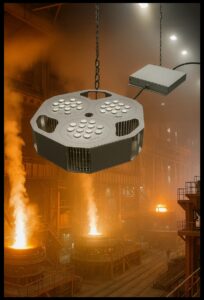
The LED chip itself is the first line of defense against heat-related failure. Standard LED chips, commonly used in commercial luminaires, are optimized for efficiency at moderate temperatures but suffer rapid performance degradation when exposed to sustained heat.
High-temperature LED chips employ specialized semiconductor structures and packaging materials designed to reduce thermal resistance and maintain junction stability. Advanced die architectures allow heat to spread more evenly across the chip, reducing localized hot spots that accelerate failure.
Material selection plays a crucial role. High-temperature LEDs often use substrates and bonding materials capable of maintaining mechanical strength and electrical integrity at elevated temperatures. These materials resist delamination and chemical breakdown that would otherwise occur under prolonged heat exposure.
Thermal stability directly impacts lumen maintenance and color consistency. As junction temperature rises, LEDs experience wavelength shifts that can alter correlated color temperature (CCT) and reduce visual uniformity. High-temperature LED chips are engineered to minimize these shifts, ensuring stable light output even under extreme operating conditions.
Heat sinks are not merely passive accessories in high-temperature LED luminaires; they are structural components that define the system’s thermal performance. In extreme heat, conventional finned aluminum heat sinks often prove insufficient, as the temperature differential between the luminaire and ambient air is too small to drive effective convection.
Material selection becomes critical. High-grade aluminum alloys with enhanced thermal conductivity are commonly used, while copper or composite metal solutions may be employed in applications requiring maximum heat spreading. These materials must also resist oxidation, deformation, and mechanical fatigue at elevated temperatures.
Heat sink geometry is carefully optimized to balance surface area, mass, and airflow. In dusty or contaminated environments, overly dense fin structures can trap debris, reducing thermal performance over time. High-temperature designs therefore favor robust geometries that maintain effectiveness even under adverse conditions.
In most extreme environments, passive cooling is preferred over active cooling. Fans and moving parts introduce additional failure points and are often incapable of surviving sustained heat. As a result, high-temperature luminaires rely on purely passive thermal solutions engineered for long-term reliability.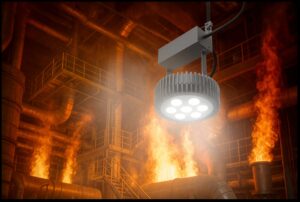
While LED chips generate light, the driver determines whether that light can be delivered reliably under extreme conditions. In many cases, the driver is the most vulnerable component in a lighting system, as electronic components such as capacitors and semiconductors are highly sensitive to heat.
High-temperature LED drivers are built using components rated for extended temperature ranges. Electrolytic capacitors, which are particularly prone to heat-induced failure, are often replaced with high-temperature film capacitors or ceramic alternatives. Circuit layouts are optimized to reduce heat concentration and improve airflow within the driver enclosure.
Thermal separation is a common design strategy, physically isolating the driver from the hottest parts of the luminaire. In some designs, remote mounting is employed, allowing the driver to operate in a cooler zone while the LED head remains exposed to high temperatures.
Maintaining constant current stability under thermal stress is essential for both performance and safety. Advanced driver designs incorporate thermal protection, power derating, and fault detection to prevent catastrophic failure in extreme environments.
Internal wiring and connectors are often overlooked, yet they play a critical role in long-term reliability. Standard PVC-insulated cables quickly degrade under high heat, becoming brittle, cracked, or electrically unsafe.
High-temperature LED luminaires use specialized cabling with insulation materials such as silicone, fiberglass, or fluoropolymers. These materials maintain flexibility and dielectric strength at elevated temperatures, preventing short circuits and insulation breakdown.
Connectors and terminals are similarly engineered for heat resistance. Ceramic terminals and high-temperature alloys replace plastic components that would otherwise deform or melt. These design choices ensure stable electrical connections throughout the luminaire’s operational life.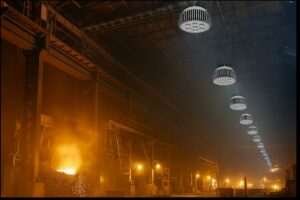
Optical components are particularly vulnerable to heat-induced degradation. Standard polycarbonate or acrylic lenses can yellow, warp, or crack when exposed to prolonged high temperatures, severely reducing light quality and output.
High-temperature LED luminaires rely on tempered glass or specialized high-temperature optics that maintain transparency and dimensional stability. These materials resist thermal expansion and chemical attack, ensuring consistent beam patterns over time.
Optical stability is essential for industrial applications where precise illumination is required for safety, inspection, or process control. By maintaining beam angle, uniformity, and luminous intensity, high-temperature optics contribute directly to operational efficiency and workplace safety.
The housing of a high-temperature LED luminaire must withstand not only heat but also mechanical stress, vibration, and corrosive atmospheres. Thermal expansion can place significant strain on fasteners, seals, and mounting points, requiring careful material selection and mechanical design.
High-temperature housings are typically constructed from aluminum alloys or stainless steel, often with specialized surface treatments to improve corrosion resistance. Protective coatings are selected to resist peeling, cracking, or chemical degradation under extreme heat.
Structural integrity is essential for maintaining IP-rated protection and ensuring that internal components remain properly aligned throughout the luminaire’s lifespan.
Maintaining ingress protection in high-temperature environments presents unique challenges. Standard rubber gaskets lose elasticity and sealing performance when exposed to heat, allowing dust, moisture, or vapors to enter the luminaire.
High-temperature sealing solutions use silicone, fluorosilicone, or other advanced elastomers capable of retaining sealing force under thermal cycling. These materials ensure consistent IP65 or IP66 protection even in harsh industrial conditions.
Effective sealing not only protects internal components but also contributes to thermal stability by preventing the ingress of contaminants that could interfere with heat dissipation.
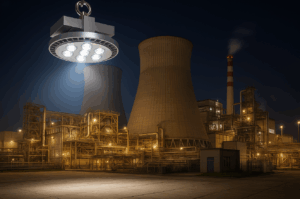
No high-temperature LED luminaire can be considered reliable without rigorous testing. Thermal aging tests simulate prolonged exposure to extreme heat, revealing potential failure modes before products reach the field.
High-temperature operational life testing evaluates performance under continuous operation, measuring lumen maintenance, electrical stability, and mechanical integrity. Failure mode analysis provides valuable insights that guide design refinement and quality control.
These qualification processes ensure that high-temperature luminaires deliver predictable, long-term performance in real-world industrial environments.
Operating LEDs in extreme heat inevitably involves trade-offs between efficiency and survivability. As temperature rises, luminous efficacy decreases, forcing designers to balance output with thermal safety margins.
Power derating is a common strategy, reducing drive current to limit junction temperature. While this may slightly reduce light output, it dramatically extends lifespan and improves reliability.
Optimizing energy efficiency in high-temperature environments requires a holistic approach that considers thermal design, electrical control, and application-specific requirements.
High-temperature LED solutions are rarely one-size-fits-all. Designing for 90°C, 150°C, or 200°C environments requires different material selections, thermal strategies, and electrical configurations.
Modular design approaches allow manufacturers to customize luminaires for specific temperature ratings without redesigning the entire system. This flexibility enables cost-effective solutions tailored to individual applications.
Customization ensures that each luminaire delivers optimal performance without unnecessary overengineering.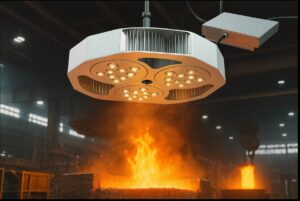
High-temperature LED lighting is essential in metal foundries, glass manufacturing plants, ceramic kilns, industrial ovens, and military facilities. In each case, reliable illumination improves safety, productivity, and operational efficiency.
By replacing failure-prone conventional lighting, high-temperature LEDs reduce maintenance costs and downtime, delivering long-term value in demanding environments.
Advances in materials science, thermal modeling, and smart electronics continue to push the boundaries of what high-temperature LEDs can achieve. Emerging technologies promise improved efficiency, real-time thermal monitoring, and predictive maintenance capabilities.
As industrial processes evolve, lighting systems will increasingly integrate with automation and data-driven maintenance strategies, further enhancing reliability and performance.
High-temperature LED lighting represents a convergence of thermal engineering, materials science, and electronic design. By addressing heat as a fundamental design challenge rather than a secondary consideration, these systems deliver reliable illumination where conventional solutions fail.
Purpose-built high-temperature LEDs offer not only durability but also improved safety, efficiency, and lifecycle value. As industrial environments continue to demand more from lighting systems, engineered solutions designed for heat will remain essential.
–The End–