
Industrial facilities that operate under extreme heat—such as metal smelting plants, foundries, glass factories, ceramic kilns, forging workshops, and furnace corridors—face one of the most difficult lighting challenges in the world. These environments push lighting systems to their limits: temperatures regularly reach 60–200°C, airborne dust and metal particles are constant, vibration from heavy equipment is unavoidable, and maintenance tasks often involve physical danger.
In such conditions, standard LED lights fail quickly because their electronic components, especially drivers and LED chips, cannot tolerate sustained heat. Metal-halide (MH) and high-pressure sodium (HPS) lamps, though more heat-tolerant, pose their own issues: they consume enormous power, degrade rapidly, generate excessive heat, and require frequent replacement. All of these factors reduce productivity and increase operating cost.
High-temperature UFO LED lights were engineered to solve precisely these challenges. Designed with heavy-duty aluminum die-cast housings, oversized heat sinks, high-temperature drivers rated for 90°C, 150°C, and up to 200°C, and an exceptionally efficient 150 lm/W LED package, these fixtures deliver stable, reliable illumination in the world’s harshest industrial spaces.
With wattage options including 50W, 100W, 200W, 300W, and 400W, and ingress protection up to IP66, these UFO lights withstand intense thermal loads while providing consistent lighting for safety-critical tasks. Their compact UFO structure offers a 360° heat-dissipating profile and easy ceiling or hook installation.
This article explains why high-temp UFO LED lights are the ideal choice for manufacturing, smelting, and furnace environments—and how they deliver unmatched durability, efficiency, and worker safety compared to traditional lighting systems.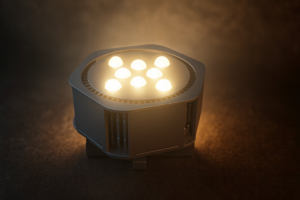
Extreme industrial environments place an extraordinary strain on equipment, especially lighting. To appreciate the value of high-temperature UFO LED lights, it’s important to understand the conditions they must endure.
2.1 Heat Characteristics in Manufacturing, Smelting & Furnace Areas
Different industrial environments produce heat in different ways—and not all lighting products can tolerate them:
Many manufacturing facilities operate at high ambient temperatures due to:
Even spaces not directly connected to smelting or furnace lines may maintain ambient temperatures above 60–90°C, which is beyond the safe operating range of most LED luminaires.
Foundries, smelting plants, and forging workshops generate intense radiant heat, especially around:
Temperatures in these zones can spike rapidly to 200°C or beyond, especially when furnace doors are opened or molten metal is poured.
A lighting fixture installed in these areas must withstand:
This level of stress causes rapid LED degradation unless the system is specially engineered.
Some production lines include enclosed or semi-enclosed environments where heat becomes trapped:
These narrow spaces can exceed 150–180°C regularly, leaving no margin for conventional lighting to survive.
2.2 Dust, Chemicals, and Mechanical Stress
Heat alone is not the only threat. Industrial environments also introduce other destructive conditions.
Manufacturing and smelting areas produce large quantities of airborne contaminants:
These particles are abrasive, corrosive, and often electrically conductive. If they enter a lighting fixture, they can cause:
This is why IP66 protection, fully sealed housings, and dust-proof connectors are essential.
Smelting and foundry environments may include chemical interactions such as:
These vapors corrode metal and deteriorate plastic lenses and LED drivers. High-temp UFO LED lights use:
This allows operation in chemically hostile locations.
Manufacturing plants and smelting workshops commonly have:
Vibration causes premature failure in:
UFO LED fixtures contain solid-state LED chips, shock-resistant housings, and robust internal wiring, giving them excellent performance under continuous vibration.
2.3 Why Standard Lighting Fails in Extreme Heat
Many lighting products are sold as “industrial-grade,” but few are genuinely suited for high-temperature environments. Here’s why typical lighting systems fail:
Standard LED drivers are typically rated for 50–70°C ambient conditions. Once they exceed this limit:
High-temp UFO LED lights use:
At temperatures above 80–100°C:
High-temperature UFO LEDs use heat-resistant tempered glass or specialized high-temp polycarbonate, maintaining clarity over time.
Although MH and HPS lamps tolerate heat better than standard LEDs, they:
A 400W metal halide lamp consumes ~450–480W including ballast losses, while a 400W high-temp UFO LED produces far more usable light at 150 lm/W, while consuming less than half the electricity.
In smelting plants or furnace corridors, changing a faulty lamp means:
Lights that fail frequently cost much more than their purchase price due to labor, downtime, and safety risks.
High-temp UFO LEDs minimize these issues through:
When furnace doors open, temperatures can spike suddenly. When they close, the air cools.
Most fixtures cannot handle this thermal cycling. High-temp UFO LEDs with aluminum heat sinks and robust thermal paths survive these swings without structural deformation.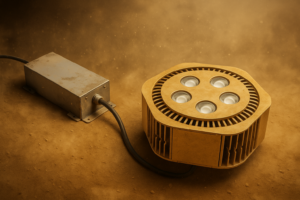
High-temperature UFO LED fixtures were engineered from the ground up to survive in extreme industrial environments where ordinary lighting fails. Their components—LED chips, heat sinks, drivers, lenses, housing, seals—are specially designed for operation in 90°C, 150°C, and 200°C ambient heat.
Below is a deep technical look at the engineering behind these fixtures and why they perform so reliably in smelting plants, glass factories, foundries, and furnace corridors.
3.1 Specialized Thermal Engineering
The hallmark of a high-temp UFO LED light is its oversized, radial heat sink, built from high-purity aluminum or copper alloy.
The UFO shape is not just for aesthetics—it is a 360° thermal dissipation architecture enabling:
For operations around 150–200°C, efficient heat dissipation is not optional. It is the difference between 50,000 hours and rapid failure.
Unlike normal LEDs rated for 25–45°C ambient temperature, high-temp LEDs use:
These chips continue functioning even when surrounding temperatures climb toward 150°C+.
Drivers are the most vulnerable component in any LED fixture. In high-temperature UFO lights, the driver is:
This prevents driver failure during severe thermal stress, ensuring continuous light output.
Every component must withstand extreme temperatures:
| Component | High-Temp Material | Benefit |
| LEDs | High-temp packaged chips | No color shift, stable output |
| Lens | Tempered glass or high-temp PC | No yellowing/cracking |
| Housing | Die-cast aluminum alloy | Corrosion & heat resistance |
| Gaskets | Silicone or fluorosilicone | Maintains IP66 seal |
| Wiring | Teflon-coated copper | High-temp insulation |
This material selection allows long-term operation where other fixtures deform or fail.
3.2 High-Efficiency Output (150 lm/W)
High-temperature environments make lighting efficiency even more critical. High-temp UFO LEDs maintain an impressive 150 lumens per watt, providing exceptional output even under thermal load.
This efficiency translates to:
Performance Comparison
| Fixture Type | Power | Typical Efficacy | Effective Brightness | Heat Emission | Lifespan |
| High-Temp UFO LED | 200W | 150 lm/W | Very high | Low | 50,000–100,000 h |
| Metal Halide | 400W | 80–100 lm/W | Medium | Very high | 5,000–8,000 h |
| HPS | 400W | 90–130 lm/W | Low (poor CRI) | High | 10,000–12,000 h |
A 200W high-temp UFO LED replaces a 400–500W MH or HPS lamp, cutting energy usage by more than half while delivering better, more consistent illumination.
3.3 Rugged, Industrial-Grade Build
High-temp sites are unforgiving, which is why these fixtures have an extremely robust design.
IP66 ensures:
This sealing prevents conductive dust or moisture from entering the housing.
The mechanical strength of the housing enables:
The structure is virtually unbreakable in industrial conditions.
LEDs have no filaments or arc tubes that can break. Combined with:
They operate reliably even in continuous vibration zones.
3.4 Stable Performance in Extreme Heat
The key advantage of high-temp UFO lighting is stability.
Unlike MH/HPS lamps that dim when overheated or lose light as they age, high-temp LED lights maintain:
The thermal path ensures:
Thanks to high-temperature lenses:
High-temperature UFO LEDs can achieve:
Their reliability saves enormous maintenance cost.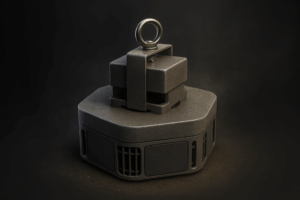
Let’s break down the real-world advantages these high-temperature fixtures deliver in manufacturing and smelting environments.
4.1 Enhanced Safety and Visibility
Safety is the top priority in high-risk industrial sites.
High-temp UFO LEDs provide:
Clear visibility dramatically reduces:
In areas like molten metal pits or furnace loading zones, visibility is critical to avoid life-threatening accidents.
4.2 Lower Maintenance Requirements
Replacing a light in a smelting plant or furnace corridor is dangerous and requires scheduled downtime.
High-temp UFO LEDs help by:
This means fewer:
Maintenance savings often exceed the fixture’s purchase cost within the first year.
4.3 Significant Energy Savings
High-temp UFO LEDs cut energy use by:
Example:
| MH/HPS | UFO LED |
| 400W MH system (incl. ballast) = 480W | 200W LED = 200W |
| Power savings = 280W per fixture | Equivalent brightness |
For smelting plants with 100+ fixtures, this is tens of thousands of dollars saved annually.
4.4 Greater Operational Reliability
Unlike traditional lamps that flicker, fade, or shut off due to heat, high-temp UFO LEDs:
Their steady performance ensures uninterrupted production.
Part 3 — Applications + Selection Guide (~1,250 words)
High-temperature UFO LED lights are specifically engineered to endure the most intense industrial environments on the planet. To maximize their value, it’s important to understand where they provide the greatest advantages and how to choose the correct wattage, temperature rating, and configuration for your facility.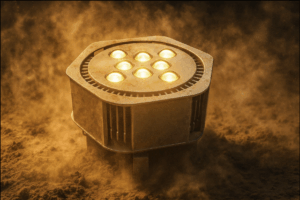
Below are the most common industrial settings where high-temperature LED solutions outperform all traditional lighting systems.
5.1 Metal Smelting & Foundry Environments
Smelting plants and foundries expose lighting to direct radiant heat from molten metal, sparks, hot slag, and continuous vibration from heavy machinery.
Typical Areas
Lighting Challenges
High-temp UFO LEDs excel here because they maintain brightness, resist heat shock, and eliminate frequent bulb replacements in these high-risk areas.
5.2 Steel Mills and Foundry Workshops
Steel production areas feature immense heat from both continuous processes and giant industrial equipment like reheating furnaces, ladle furnaces, and rolling mills.
Common Install Locations
High-temp UFO LED fixtures provide high LUX levels essential for precision tasks and safety during material transport.
5.3 Glass Manufacturing & Melting Facilities
Glass smelting involves furnace temperatures reaching well above 1,400°C. While ambient ceiling temperatures may not be this high, the radiant heat is extreme.
Application Zones
High-temp LED fixtures withstand the radiant heat and maintain clear, uniform light for quality inspection.
5.4 Ceramic & Brick Kilns
Ceramic, tile, and brick kilns operate with massive interior temperatures and high dust levels. Temperature near the kiln mouth is often above 120–150°C.
Lighting Locations
High-temp LEDs with IP66 dust protection ensure reliable operation regardless of ceramic or refractory dust accumulation.
5.5 Heat-Treatment & Forging Plants
Forging and heat-treatment facilities face unique challenges:
Applications
High-temp UFO LEDs maintain consistent brightness for workers handling glowing metal and operating heavy machinery.
5.6 Industrial Baking, Curing & Food Processing Heat Tunnels
High-temperature LED fixtures are also used in:
These areas have long periods of 80–120°C ambient heat, which standard fixtures cannot survive.
5.7 General Manufacturing Plants with High Ambient Heat
Even outside furnace zones, many factories operate in 60–90°C environments:
High-temp UFO LEDs reduce cooling load and provide stable illumination with no lumen degradation.
Selecting the correct model ensures maximum performance, longevity, and safety. Below is a complete guide based on wattage, temperature rating, optical performance, and installation height.
6.1 Selecting Based on Temperature Rating
The first step is identifying the heat conditions in the installation zone.
Best for:
Advantages:
Best for:
Advantages:
Best for:
Advantages:
Rule of Thumb:
If workers wear heat-resistant gear in the area, you should use 150–200°C rated UFO LEDs.
6.2 Selecting Based on Wattage (50W / 100W / 200W / 300W / 400W)
Wattage selection should be based on ceiling height, required brightness, and area size.
50W High-Temp UFO LED
100W High-Temp UFO LED
200W High-Temp UFO LED
300W High-Temp UFO LED
400W High-Temp UFO LED
6.3 Beam Angle and Optical Requirements
The beam angle determines how light is distributed.
Popular Options
Application Tips
6.4 Important Certifications and Standards
To ensure safety and compliance, choose lights with:
These certifications guarantee safety, electromagnetic stability, and environmental protection.
6.5 Installation Recommendations
Fixtures should be mounted away from:
Even high-temp LEDs require minimal airflow around the heat sink.
Especially important in steel mills and forging plants.
Plan for:
For lower-heat areas, integrating smart control can reduce energy consumption further.
High-temperature UFO LED lights do far more than simply survive in harsh environments—they also transform operational efficiency, reduce downtime, and deliver substantial long-term financial returns. This final section explores ROI, cost savings, sustainability benefits, and wraps up with a strong conclusion and SEO tags.
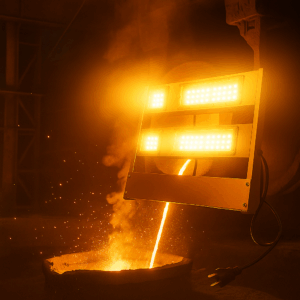
High-temperature industrial environments—such as smelting plants, foundries, and furnace corridors—typically operate under intense energy consumption and expensive maintenance cycles. Lighting is a major cost contributor, not only because traditional lamps are inefficient, but also because they burn out rapidly under high heat.
Upgrading to high-temp UFO LED lights yields measurable, long-term financial benefits.
7.1 Direct Energy Savings (60–75% Reduction)
The most immediate financial gain comes from cutting electricity usage.
Energy Consumption Comparison
| Fixture Type | Power Consumption | Equivalent Light Output | Annual Energy Cost (Based on 24/7 operation, $0.12/kWh) |
| 400W Metal Halide | ~480W (incl. ballast) | Baseline | ~$505/year |
| 200W High-Temp UFO LED | 200W | Higher brightness | ~$210/year |
| Savings per fixture | — | — | ~$295/year |
For facilities with 100 fixtures, that is:
$295 × 100 = $29,500/year saved on electricity alone.
And since your product delivers 150 lm/W efficiency, this gap is even larger compared to lower-efficiency LED or HID alternatives.
7.2 Maintenance Savings and Downtime Reduction
Lighting maintenance is costly in industrial heat zones, not because of parts—but because of downtime, manpower, and risk.
Traditional Lighting Issues
High-Temp UFO LED Benefits
If a factory normally replaces HID lamps 2–4 times per year in hot zones, switching to a high-temp LED eliminates these cycles completely.
Estimated Annual Maintenance Savings
For a medium foundry, this often totals:
$200–$500 per fixture per year saved.
Combine this with energy savings, and upgrading becomes a powerful business decision.
7.3 Productivity and Safety Improvements
Lighting isn’t just a cost—it’s a productivity and safety factor.
Better Lighting Improves Worker Performance
Fewer Accidents and Equipment Errors
Poor lighting is a major cause of industrial accidents, especially in hot zones where workers already face:
High-temp UFO LEDs provide uniform, stable lighting with high CRI (better color accuracy), reducing misjudgments and hazards.
7.4 Heat Reduction and Lower HVAC Load
A surprising but important benefit:
LEDs emit far less heat than HPS/MH lamps.
This reduces heat buildup in already hot environments, helping:
While this effect is most notable in enclosed factory spaces, even semi-open smelting halls see improved thermal balance.
7.5 Long-Term Reliability and ROI Payback
When all savings are combined—energy, maintenance, downtime, safety—the payback period for high-temp UFO LEDs is rapid.
ROI Example Calculation
Assuming:
Total annual savings per fixture =
$295 + $300 = $595
ROI payback period =
$400 ÷ $595 ≈ 8 months
After that, the fixture continues saving money every year.
In most industrial environments, payback occurs in 6–12 months, with total lifetime savings reaching $3,000–$8,000 per fixture.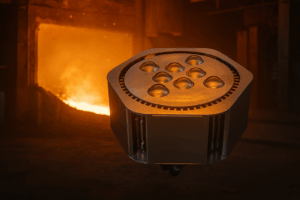
Modern industry faces increasing pressure for sustainability compliance. High-temp UFO LEDs support environmental goals and regulatory requirements.
8.1 Lower Carbon Emissions
Energy reduction directly translates to carbon reduction.
Typical CO₂ emissions per kWh: 0.92 lbs
Energy saved per fixture per year: ~2,460 kWh
CO₂ reduced per fixture: ~2,263 lbs/year
For 100 fixtures:
226,000 lbs of CO₂ reduced annually
8.2 No Mercury or Hazardous Materials
Unlike metal halide or fluorescent lighting, LEDs contain:
This makes disposal safer and avoids environmental contamination.
8.3 Better Compliance With Safety Standards
Industrial facilities must meet:
High-temp LEDs exceed most of these requirements and add additional safety by maintaining full lumen output even under heat stress.
High-temperature UFO LED lights are not simply an upgrade—they are a necessary evolution for any facility operating in extreme heat, dust, vibration, or corrosive environments.
Traditional lighting systems (HPS, MH, halogen) fail repeatedly in these conditions, causing:
High-temp UFO LEDs—especially with specifications like:
—deliver consistent performance where other lights fail.
They provide:
For smelting plants, steel mills, foundries, glass factories, ceramic kilns, forging shops, and furnace corridors, these lights are the most dependable solution available on the market.
Industrial customers adopt high-temp UFO LEDs for one reason:
they work flawlessly where everything else burns out.
–The End—