Industrial facilities—particularly foundries, steel mills, glass plants, and heavy manufacturing lines—push lighting systems to their limits. Extreme heat, airborne dust, corrosive gases, vibration, and 24/7 operation create an environment where most conventional fixtures fail prematurely. In many worksites, lighting is not just a matter of illumination—it is a frontline safety feature. Workers depend on stable, bright, consistent light to navigate hazardous equipment, handle molten materials, avoid collisions, and maintain precision in fast-paced operations.
This is where 150 lm/W heat-resistant LED fixtures, especially UFO-design high-temperature high bays, have become essential. Engineered to operate reliably at 90°C, 150°C, and even 200°C ambient conditions, these LEDs deliver efficiency, longevity, and superior visibility even under the most punishing industrial conditions.
This article provides a comprehensive look at how heat-resistant LEDs enhance workplace safety, reduce operational risk, and support productivity across high-temperature industrial facilities. With roughly 5,000 words of deep insight, this piece also serves as a powerful educational blog, SEO content asset, or technical brochure for your company website.
Industrial environments are among the toughest workplaces on Earth. Temperatures may exceed 100°C, airborne particles may coat every surface, and heavy machinery may operate nonstop with little tolerance for visibility lapses. Yet many facilities still rely on outdated HID, HPS, or metal halide fixtures that struggle to perform under these harsh conditions.
Traditional lighting in extreme environments suffers from:
In industries where molten steel is poured, glass is fired at over 1,000°C, or kilns run continuously, heat is not just an environmental factor—it is a structural challenge.
The introduction of high-heat-resistant LED fixtures—optimized with thermal pathways, robust drivers, and heat-tolerant components—has transformed industrial lighting design. These LEDs produce 150 lumens per watt, significantly outperforming older technologies while offering unmatched thermal resilience.
Whether installed in foundries, smelting lines, firing plants, military facilities, or high-heat machinery rooms, heat-resistant LEDs ensure that lighting remains reliable, safe, and efficient even in the most demanding settings.
Adequate lighting is one of the most influential—and often underestimated—factors in preventing industrial accidents. According to workplace safety research, poor visibility contributes directly to:
In high-risk environments where workers handle hot metals, heavy equipment, or hazardous chemicals, visibility becomes a matter of life and death.
2.1 How Much Light Does an Industrial Worksite Need?
Standards such as OSHA and EN12464 specify lighting requirements for different types of industrial spaces:
| Industrial Area | Recommended Illuminance |
| Foundries & Heavy Manufacturing | 200–500 lux |
| Quality Control | 500–750 lux |
| Assembly Lines | 300–500 lux |
| Loading Bays | 150–300 lux |
| Warehouses | 100–200 lux |
Achieving these levels is difficult in spaces where fixtures are mounted at 10–30 meters or exposed to extreme heat. Traditional lighting dims significantly over time, creating dangerous dark zones.
2.2 Stable Lumen Output Improves Hazard Detection
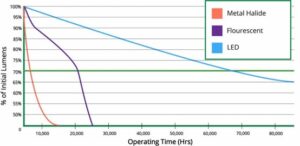
Unlike HID lamps that rapidly degrade, LEDs—especially high-temperature-rated models—maintain:
This stability allows workers to detect hazards earlier, avoid mistakes, and maintain high productivity.
In high-heat environments, stable visibility is a safety shield, ensuring that workers can react quickly and accurately to fast-changing conditions.
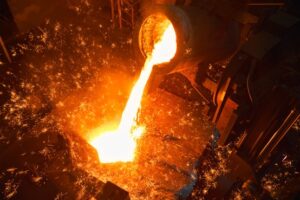
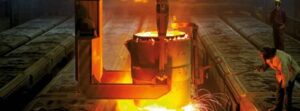
Lighting in a typical factory is challenging—but in environments where furnaces operate at thousands of degrees, the entire ceiling becomes a heat chamber. Airborne dust, metal particles, and oil vapors further stress electrical components.
3.1 How Heat Damages Lighting Systems
LEDs are semiconductors, and semiconductors do not like heat. Excessive temperature can cause:
Many standard LEDs are only rated for 40°C–50°C ambient temperatures. At 70°C and above, most degrade rapidly.
3.2 Heat Failure in HID and Metal Halide Fixtures
Traditional industrial fixtures fare even worse:
In a foundry or kiln area, this can be catastrophic.
3.3 Dust, Vibration, and Corrosive Air
In addition to heat, industrial environments feature:
The lighting must remain sealed, stable, and dust-resistant, or else dust accumulation becomes a fire hazard.
3.4 Why Many LEDs Fail Above 60–70°C
Typical commercial LEDs are built for comfort-zone temperatures. Their thermal pathways cannot disperse heat fast enough, leading to:
High-temperature LEDs solve these weaknesses through specialized engineering.
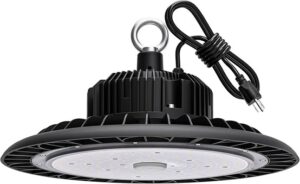
Heat-resistant LED high bays—especially UFO models—are designed specifically for environments where conventional lighting simply cannot survive.
4.1 Advanced Thermal Management
Key features include:
These features keep the LED junction temperature stable even in 150–200°C ambient environments.
4.2 High-Temperature LED Chips
Conventional LED chips degrade rapidly at 80°C+. Heat-resistant LEDs used in industrial high bays are selected for:
This ensures long-term output stability.
4.3 High-Temperature Resistant Drivers
Drivers are often the first component to fail in high-heat environments. Specialized heat-resistant LEDs use:
This driver design supports continuous operation near furnaces, kilns, and smelting lines.
4.4 Customizable Temperature Grades: 90°C / 150°C / 200°C
Different industrial zones require different thermal protections:
Matching the correct grade ensures both performance and lifespan.
4.5 Sealed UFO Structure
The UFO high bay design inherently provides:
This makes it ideal for dust-heavy or vibration-prone facilities.
The efficiency of 150 lumens per watt is not just an energy advantage—it is a safety asset.
5.1 Higher Efficiency = Better Illumination Coverage
Higher efficiency means more light per watt, which allows:
In tall-ceiling applications (10–30 meters), this is crucial for detecting overhead hazards.
5.2 Reduced Shadows Improve Hazard Recognition
Shadows can conceal:
High-efficiency LEDs with optimized optics distribute light more evenly than HID fixtures, creating a safer visual environment.
5.3 Sharper Light Output Reduces Errors
Modern LEDs offer high CRI (Color Rendering Index), which improves:
In quality-critical environments, better color accuracy reduces defects and rework.
5.4 Lower Eye Strain Supports Worker Performance
Workers exposed to dim or inconsistent lighting often experience:
High-efficiency LEDs stabilize brightness and minimize flicker, improving alertness and reducing stress.
5.5 Ideal for Tall Ceilings and Wide Areas
150 lm/W LEDs can be deployed effectively in:
Their high lumen output ensures floor-level illumination even when mounted high above operations.
Lighting failure in a high-risk industrial environment can trigger severe accidents. Reliability is therefore a safety attribute—not just a maintenance concern.
6.1 Consistent Performance Under Extreme Temperatures
Heat-resistant LEDs:
even at 90°C, 150°C, or 200°C environments.
This eliminates the unpredictable performance of traditional lamps.
6.2 Reduced Maintenance Requirements
Climbing 20–30 meters to replace fixtures in a hot factory is dangerous and expensive. Heat-resistant LEDs:
6.3 Preventing Sudden Blackouts
HIDs require long restrike times. If power dips for even a second, the workspace plunges into darkness—a major hazard.
LEDs restore full brightness instantly, preventing dangerous downtime.
6.4 24/7 Reliability for Heavy Industry
Continuous-operation facilities trust high-temp LEDs because they:
This stability keeps workflows undisrupted and workers protected.
Heat-resistant LEDs still deliver top energy performance, even in extreme conditions.
7.1 Cutting Energy Use by 50–70%
Compared with HID, HPS, or metal halide systems, 150 lm/W LEDs reduce power consumption dramatically. For example:
This leads to:
7.2 Reduced Heat Emission Supports Cooling Efficiency
Traditional lamps emit a significant amount of heat. LEDs reduce thermal output, helping:
7.3 Sustainability Benefits
Better energy performance aids:
Industries with heavy energy consumption greatly benefit from LED upgrades.
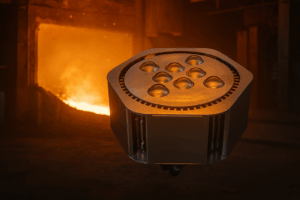
Heat-resistant LEDs are used across a wide spectrum of industrial applications.
8.1 Metal Smelting & Foundries
Foundries have extreme thermal gradients and airborne metal particles. LEDs near furnaces or casting lines must withstand very high ambient heat, making 150–200°C rated fixtures essential.
8.2 Glass Manufacturing Plants
Glass plants operate furnaces above 1,000°C. Workers require stable visibility around molten product and conveyor systems. Heat-resistant LEDs improve process control and reduce visual hazards.
8.3 Ceramic & Tile Firing Factories
Kilns and firing chambers emit continuous heat. Dust and ceramic powder add additional stress to lighting housings. High-temp LEDs ensure stable illumination despite harsh conditions.
8.4 Industrial Baking & Curing Chambers
These enclosed spaces operate at elevated temperatures, making normal fixtures unsuitable. Heat-resistant LEDs ensure consistent illumination during inspection and quality checks.
8.5 Military & Desert Installations
High ambient temperatures, sand, and dust demand lighting with:
Heat-resistant industrial LEDs excel in such environments.
Selecting the correct fixture is crucial to ensuring long-term safety and performance.
9.1 Choose the Appropriate Temperature Rating
Always match fixture rating to ambient temperature.
9.2 Select Correct Wattage for Mounting Height
| Mounting Height | Recommended Wattage |
| 5–10m | 50W–100W |
| 10–15m | 100W–150W |
| 15–20m | 150W–200W |
| 20–25m | 200W–300W |
| 25–30m or above | 300W–400W |
Oversizing is sometimes necessary in dusty or high-heat zones.
9.3 IP & IK Protection Ratings
For dusty, corrosive, or mechanical-impact environments:
9.4 Beam Angle Selection
Optical lenses improve uniformity and reduce glare.
9.5 Optional Controls and Sensors
Though high-heat areas rarely use smart controls due to thermal stress, certain zones may benefit from:
Choose sensors rated for high temperatures.
10.1 Foundry Safety Improvement
A forging plant upgraded from 400W HID to 200W high-temp LEDs:
10.2 Glass Factory Efficiency Gain
A glass manufacturer using 150°C-rated LEDs saw:
10.3 Ceramic Plant Reliabilty
After switching to 200°C-rated fixtures:
High-temperature industrial environments demand lighting systems that can withstand punishing operational conditions. 150 lm/W heat-resistant LED fixtures provide the brightness, durability, and thermal resilience necessary to ensure:
From foundries and glass plants to ceramic factories and heavy manufacturing, heat-resistant LEDs are transforming industrial lighting strategy. Their combination of efficiency, rugged engineering, and thermal robustness makes them essential for any facility where safety and performance cannot be compromised.
–The End–