
Industrial facilities across the globe rely on continuous, high-quality lighting to maintain safety, productivity, and operational efficiency. Whether it is a steel mill running 24/7, a chemical plant operating under strict process controls, or a glass manufacturing line working in extreme furnace environments, illumination is not merely a convenience—it is a critical infrastructure element.
In environments where ambient temperatures can soar to 90°C, 150°C, or even beyond 200°C, conventional lighting solutions often fail prematurely, leading to downtime, safety risks, and costly maintenance interruptions. Equipment reliability under such conditions is non-negotiable. Workers navigating dangerous machinery, engineers monitoring production lines, and operators overseeing quality control all depend on reliable illumination to perform effectively and safely.
This is where industrial-grade, high-temperature LED lighting has transformed the equation. Unlike traditional lighting technologies that degrade rapidly under heat stress, modern LED fixtures engineered for extreme environments provide consistent performance, energy efficiency, and long lifespans—even under the most demanding conditions. This article explores the unique challenges of high-temperature industrial illumination, the technological solutions available, and the growing role of advanced LED systems in ensuring reliability where it matters most.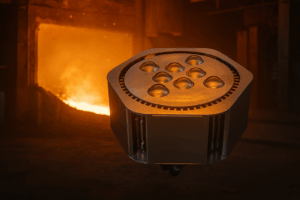
Industrial facilities present some of the harshest operating conditions for electrical equipment. Lighting, in particular, faces unique stresses due to constant exposure to heat, dust, vibration, and sometimes chemical vapors.
Industries Exposed to Extreme Heat
Failures of Conventional Lighting
The outcome of these failures includes unscheduled maintenance, production downtime, and in the worst cases, workplace accidents due to inadequate visibility. Reliable illumination is therefore not just about energy savings—it is a mission-critical safety and productivity requirement.
Designing lighting systems for extreme industrial heat is not a trivial task. Every component—from housing materials to electronic drivers—must withstand prolonged thermal exposure without performance degradation.
Thermal Management
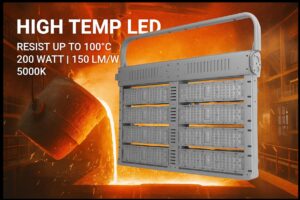
Heat is the primary enemy of LED performance and lifespan. Without effective thermal management, LEDs experience lumen depreciation, color shift, and eventual catastrophic failure. Solutions include:
Material Durability
At high temperatures, plastics and conventional glass may warp, crack, or discolor. Reliable high-temperature luminaires therefore require:
Optical Stability
LED phosphor materials and lenses must be engineered to resist yellowing, optical distortion, or loss of transparency under constant heat stress.
Electronics and Driver Protection
Electronic drivers are particularly sensitive to heat. Solutions include:
LED lighting has proven to be the superior solution for high-temperature industrial environments for several reasons:
Not all industrial environments are created equal. Lighting must be tailored to specific thermal conditions.
90°C-Rated Fixtures
These are ideal for moderately hot environments such as mechanical rooms, high-bay warehouses with elevated ambient heat, and production areas where localized equipment generates significant but not extreme temperatures.
150°C-Rated Fixtures
Applications include heavy industrial processes such as foundries, forging facilities, chemical plants, and boiler rooms. Fixtures must be designed with robust heat sinks, specialized optics, and high-temperature-resistant drivers.
200°C-Rated Fixtures
Reserved for the harshest conditions—smelting operations, kiln inspection zones, or glass furnace environments—these luminaires are engineered with maximum durability. Often, they employ remote drivers, heavy-duty housings, and materials capable of continuous exposure to 200°C without degradation.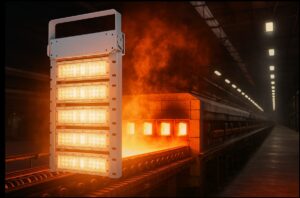
Lighting reliability directly impacts worker safety. Poor illumination increases risks of accidents, impairs precision in tasks, and can even violate regulatory compliance standards.
Certifications such as UL, CE, ATEX, and IECEx ensure that fixtures are safe not only against thermal failure but also against risks of fire, explosion, and electrical hazards. High-temperature LEDs help facilities meet Occupational Safety and Health Administration (OSHA) requirements and international industrial safety codes.
While high-temperature LED fixtures may carry a higher upfront cost, the return on investment is compelling:
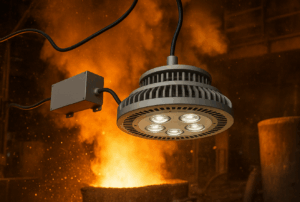
Reliable illumination in high-temperature industrial applications is more than just a matter of convenience—it is an operational necessity. From ensuring worker safety to maintaining production efficiency, lighting is integral to every industrial process.
LED technology, with its unparalleled efficiency, thermal resilience, and long service life, has redefined what is possible in environments that were once deemed too harsh for reliable lighting. By adopting LED systems engineered specifically for 90°C, 150°C, and 200°C applications, industries gain not only immediate operational benefits but also long-term sustainability and cost savings.
In the world’s most demanding environments, reliable illumination is productivity, safety, and progress made visible.
–The End–