
Modern industry is built on efficiency, precision, and safety. Yet few operational challenges are as persistent and unforgiving as extreme heat. Whether in steel plants, glass furnaces, chemical refineries, or cement factories, the combination of high ambient temperatures and continuous operations places extraordinary demands on every piece of equipment — including lighting.
Lighting in such environments is more than a convenience; it is a critical safety and productivity enabler. Workers in high-heat facilities depend on illumination for visibility, accuracy, and accident prevention. Any failure in lighting systems under extreme thermal stress can lead to costly downtime, compromised safety, or even catastrophic hazards.
Traditionally, lighting solutions in these settings relied on high-pressure sodium (HPS), metal halide lamps, or halogen technologies. While capable of withstanding short bursts of heat, these older systems suffer from inefficiency, frequent replacement needs, and poor luminous quality. Their short service life in extreme conditions significantly increases operational costs.
Enter high-temperature LED lighting solutions — engineered specifically to operate reliably in environments of up to 200°C. These next-generation luminaires combine advanced thermal engineering, robust material science, and industry-leading energy efficiency. With luminous efficacy reaching 150 lm/W, and power ranges from 50W to 400W, they deliver both the rugged durability required for hostile environments and the performance standards demanded by modern industries.
This article explores why high-temperature LED lighting is not only possible but essential, how these systems are engineered to thrive under relentless thermal pressure, and the broad spectrum of applications where they prove indispensable.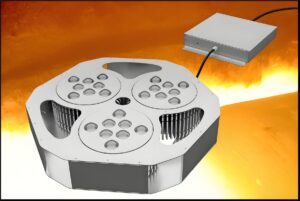
In high-heat workplaces, reliable illumination is directly tied to worker safety. Facilities such as foundries or boiler plants are often dim, smoky, and filled with particulates. Poor lighting increases the risk of accidents, from missteps and collisions to severe operational errors. In many cases, critical inspections and manual interventions must take place right next to molten metal, hot gases, or mechanical furnaces.
A light fixture failing under these conditions doesn’t simply mean reduced visibility; it can jeopardize lives. High-temperature LEDs ensure consistent, stable light output in areas where operational safety is non-negotiable.
High-temperature industrial facilities often operate 24/7. Interruptions due to lighting failures or maintenance shut-downs can translate into substantial production losses. Traditional lighting technologies degrade quickly under heat, leading to frequent replacements.
LED lighting systems engineered for 90°C, 150°C, and 200°C environments dramatically reduce the frequency of replacements. Their endurance minimizes unscheduled downtime, preserving operational continuity and lowering long-term costs.
Legacy lighting systems consume excessive energy, especially in high-wattage applications. High-pressure sodium lamps and halides typically operate at lower luminous efficacy, wasting significant power. By contrast, modern high-temperature LEDs achieve 150 lumens per watt, providing brighter illumination while consuming less energy.
This efficiency translates into reduced operational costs, lower emissions, and compliance with energy standards increasingly demanded by governments and clients alike.
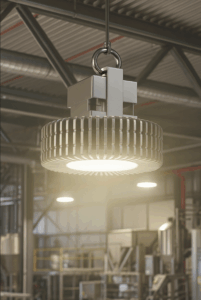
To survive at 200°C, lighting fixtures must overcome significant engineering hurdles. Every component — from the LED chips themselves to the housing, optics, and driver electronics — requires specialized design.
Effective heat management is the backbone of these luminaires:
In extreme industrial environments, dust, vibration, humidity, and corrosive chemicals are constant challenges. High-temperature LEDs are reinforced with:
The result is a luminaire that not only withstands heat but thrives in environments where multiple stresses converge.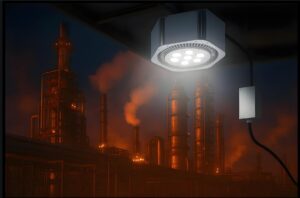
High-temperature LED solutions deliver superior performance metrics that redefine industrial lighting expectations.
This figure places high-temperature LEDs far above conventional lighting technologies, which typically hover between 80–110 lm/W. This means brighter illumination per unit of power, directly impacting visibility and energy consumption.
LED lifespans are drastically extended by effective thermal management. While conventional lighting degrades quickly at high heat, high-temperature LEDs maintain tens of thousands of operational hours without significant lumen depreciation.
In contrast, high-temperature LEDs offer superior color rendering, higher efficiency, and unmatched endurance.
High-temperature LED lighting is essential in a wide range of industries.
5.1 Heavy Industry
5.2 Energy & Power
5.3 Manufacturing
5.4 Infrastructure & Utilities
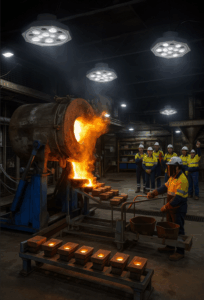
Adopting high-temperature LEDs brings measurable financial and environmental benefits.
6.1 Reduced Energy Consumption
At 150 lm/W, facilities cut energy use by 30–50% compared to legacy lamps, with no loss in brightness.
6.2 Lower Maintenance and Replacement Costs
Longer service life means fewer replacements, reducing labor costs and minimizing operational disruptions.
6.3 ROI Calculations
Over a 5-year operational cycle, total cost of ownership (TCO) favors LEDs by a wide margin. The combined impact of reduced electricity bills and minimized downtime quickly offsets initial investment.
6.4 Sustainability Benefits
Energy savings directly translate into reduced greenhouse gas emissions. Many industries are now prioritizing sustainable practices, making high-efficiency LEDs an investment in environmental responsibility.
7.1 Compliance with Global Standards
High-temperature LED luminaires are engineered to comply with IEC, UL, CE, and RoHS standards. Certification ensures performance, safety, and environmental responsibility.
7.2 Enhancing Worker Productivity
Stable, high-quality illumination with proper color rendering improves accuracy in inspections, assembly, and monitoring tasks. Workers operate more confidently in well-lit, safe environments.
7.3 Environmental Compliance
By consuming less energy and lasting longer, high-temperature LEDs reduce waste, lower emissions, and support ISO 14001 environmental management initiatives.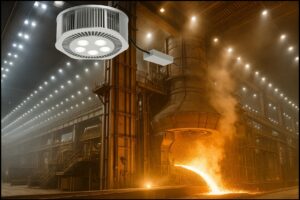
The high-temperature LED sector continues to evolve rapidly.
8.1 Smart Integration
Upcoming systems are designed to integrate with IoT platforms and industrial automation networks. Features such as adaptive dimming, remote diagnostics, and predictive maintenance are becoming standard.
8.2 Expansion of Performance Limits
R&D efforts are pushing LED reliability beyond 200°C, exploring applications in aerospace, deep mining, and military-grade environments.
8.3 Materials Innovation
Emerging nano-materials and ceramics are enabling even better thermal resilience, while improving optical clarity and efficiency.
Lighting in extreme thermal environments is not merely a technical challenge; it is a foundation of safety, productivity, and cost-efficiency. Traditional lighting technologies, while once serviceable, no longer meet the rigorous demands of modern high-heat industries.
High-temperature LED solutions rated up to 200°C, with 150 lm/W efficiency and 50W–400W power options, represent a decisive leap forward. Engineered with advanced materials, robust thermal management, and long-life performance, these luminaires deliver unmatched reliability where it matters most.
Industries that embrace this innovation gain more than just light — they secure safety, minimize operational risk, cut energy costs, and move toward a sustainable future.
The path forward is clear: for environments defined by extremes, the only lighting solution is one engineered to match them.
–The End—