
Light behaves differently underwater. Water absorbs and scatters light, especially at greater depths, making natural illumination fade rapidly. Without proper lighting, visibility, color accuracy, and safety are compromised—whether the purpose is cinematic filming, commercial fishing, or subsea engineering.
Underwater LED lighting has become the go-to solution for applications that demand brightness, efficiency, and resilience under challenging aquatic conditions. These lights are purpose-built to function in environments where moisture, pressure, and corrosion are constant threats.
Within this category are multiple specialized products:
Submersible LED filming lights – for professional cinematographers and photographers working in aquatic environments
Underwater fishing lights – designed to attract marine life and improve night fishing efficiency
Underwater emergency lights – essential for rescue, inspection, and safety operations
Subsea industrial lights – engineered for deep-sea oil, gas, and infrastructure maintenance
While all of them share core traits like waterproofing and high efficiency, each has unique technical demands shaped by its market and intended use.
The technology behind underwater LED lighting is more complex than simply sealing a bulb in a watertight housing. Engineers must address four key challenges: water pressure, corrosion, heat management, and optical clarity.
The most common measure of ingress protection is the IP (Ingress Protection) rating:
IP65–IP67: Suitable for splashes and temporary immersion
IP68: Designed for continuous underwater operation at specified depths
Special subsea ratings: Engineered for pressures found hundreds or thousands of meters below the surface, often validated by hydrostatic testing
Submersible lights intended for deep-sea use often include pressure-resistant housings made from marine-grade stainless steel, hard-anodized aluminum, or high-strength polymers.
Lighting underwater must counteract both absorption and color shift. Water filters out red and yellow wavelengths first, making scenes appear increasingly blue or green with depth. High-quality underwater LEDs address this by:
Offering high CRI (Color Rendering Index) to preserve natural tones, especially skin colors in filming
Providing RGBWW (Red, Green, Blue, Warm White, Cool White) mixing for creative and accurate color reproduction
Using beam shaping optics (spot, flood, or wide beam) for targeted illumination
Even in cold water, LEDs generate heat that must be dissipated to maintain efficiency and lifespan. Advanced designs use:
Direct thermal paths from the LED chip to the housing
Heat-conductive materials like copper cores or aluminum alloys
In some cases, passive water cooling leveraging the surrounding environment
Underwater LEDs may use:
Low-voltage DC systems for diver and ROV safety
Integrated battery packs for portability
Cable-powered solutions for continuous long-duration use
DMX/CRMX control protocols in filming lights, allowing synchronized effects and dimming
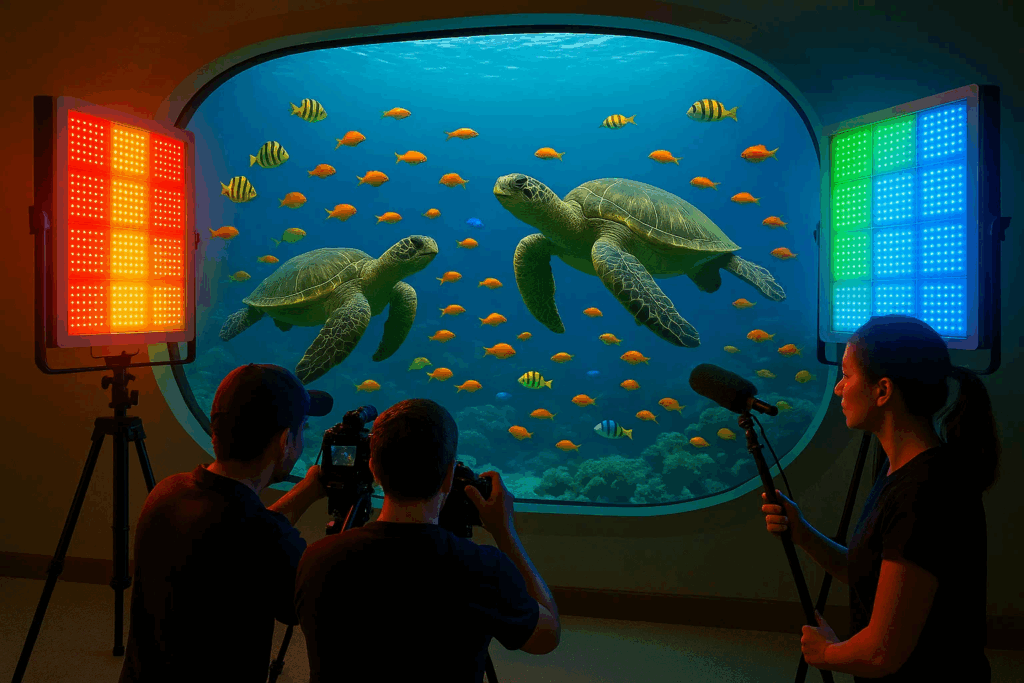
For cinematographers and underwater DPs, lighting is about storytelling, not just visibility. Shooting underwater presents unique challenges:
Reduced natural light after just a few meters
Rapid color loss, requiring compensation for accurate visuals
Constant movement caused by water currents
Underwater filming lights need:
High CRI for true-to-life skin tones and scene colors
Flicker-free operation for high-speed and cinematic frame rates
Precise beam control to avoid backscatter and haze from particles in the water
Applications range from blockbuster films and TV series to documentaries, commercials, and music videos shot in pools, oceans, or lakes.
Marine life responds to specific wavelengths of light. Commercial and recreational fishing operations use underwater LEDs to:
Attract certain species such as squid, mackerel, or shrimp
Illuminate nets and traps
Support night fishing without disturbing the surrounding ecosystem
For marine research, biologists employ underwater lights for:
Coral reef studies
Species population monitoring
Deep-sea observation with submersibles
Fishing lights are typically designed for long runtime, energy efficiency, and corrosion resistance against saltwater exposure.
In rescue scenarios, visibility can mean the difference between success and failure. Underwater emergency lights are used by:
Harbor patrol divers
Search and recovery teams
Disaster response crews
These lights emphasize:
High lumen output to penetrate murky water
Portable, battery-powered operation for mobility
Impact resistance to withstand debris and rough handling
Underwater lighting plays a critical role in infrastructure and energy sectors:
Oil & Gas: Inspecting subsea pipelines, wellheads, and drilling platforms
Maritime: Ship hull inspections, propeller checks, and port facility maintenance
Renewable Energy: Monitoring underwater wind farm structures
Construction: Supporting divers in underwater welding or assembly
Industrial lights must endure extreme pressures, temperatures, and corrosive conditions for long-term reliability.
Not all “waterproof” lights are suitable for continuous underwater use.
IP65–IP67 rated
Protected from rain, splashes, or temporary immersion
Common for outdoor architectural and landscape lighting
Not designed for extended submersion
IP68 or higher
Operates continuously underwater at specific depths
Designed with corrosion-resistant materials
Used in pools, fountains, marine vessels, and shallow to moderate diving environments
Built for depths of hundreds to thousands of meters
Pressure-resistant housings and optical domes
Often integrated with ROVs or submersible vehicles
Designed for extreme longevity and maintenance-free operation in inaccessible locations
Entertainment & Media
Feature films, TV shows, music videos, and commercials
Use of RGBWW technology for creative effects and accurate reproduction of real-world colors
Commercial Fishing
Fish aggregation in both coastal and offshore environments
Reduction in fuel costs by targeting specific fish species more efficiently
Recreational Use
Swimming pools, fountains, and aquariums
Yacht and boat lighting for aesthetics and safety
Marine Research
Coral reef health monitoring
Deep-sea biodiversity studies
Nighttime plankton tracking
Public Safety
Search and recovery in accident sites
Harbor and dam inspection
Border patrol underwater surveillance
Energy & Infrastructure
Offshore rig inspections
Bridge pier maintenance
Subsea cable route lighting during installation
The underwater lighting market is evolving alongside advancements in LED, power, and control technologies. Key developments include:
Higher Lumen-Per-Watt Efficiency – brighter lights with lower power draw
Smart Controls & Automation – adaptive lighting that adjusts intensity and color based on water clarity and scene requirements
Wireless Power & Data Transfer – eliminating cables in subsea operations
Integration with ROVs and Drones – expanding inspection and filming capabilities without human divers
AI-Assisted Lighting Adjustments – real-time optimization for image quality in filming and exploration
Underwater LED lighting is far more than a niche product—it’s a critical tool across industries. From bringing cinematic underwater scenes to life, to enabling deep-sea infrastructure maintenance, to supporting marine biology and fishing operations, these lights are designed for specific depths, environments, and goals.
Choosing between waterproof, underwater, and subsea lighting depends on more than just an IP rating—it’s about understanding pressure resistance, corrosion control, optical clarity, and power requirements for the task at hand.
In every market, one principle holds true: the right light not only illuminates but also enables the work, the art, and the safety of those who depend on it.