1. Introduction
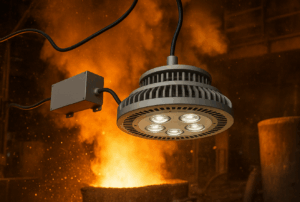
Industrial environments are rarely gentle on equipment — and lighting is no exception. In manufacturing plants, refineries, steel mills, and foundries, ambient temperatures can soar well beyond the safe operating range for most electrical components. In such harsh conditions, traditional lighting systems like metal halide, high-pressure sodium, or even standard commercial LEDs quickly succumb to heat-induced degradation. Premature failures not only disrupt productivity but also increase maintenance costs and safety risks.
This is why high-temperature-rated LED lighting — designed to operate continuously at 100°C, 150°C, and even 200°C — has become an indispensable asset for industries that cannot compromise on illumination performance. These lighting systems are engineered from the ground up to endure the punishing combination of heat, dust, vibration, and in some cases, corrosive atmospheres, while delivering superior light quality and efficiency.
In this article, we’ll explore the engineering principles behind high-temperature-rated LEDs, their application-specific advantages, and why industries are rapidly transitioning from legacy lighting technologies to modern, heat-resilient LED systems.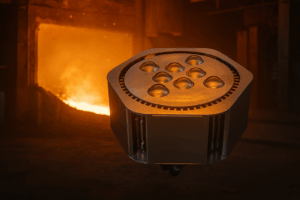
2. Why High-Temperature Rated LEDs Matter
Lighting is more than just a convenience in industrial operations — it’s a safety and productivity factor. Workers rely on consistent, bright illumination to avoid errors, prevent accidents, and ensure quality control. But in environments where temperatures can spike to triple digits Celsius, standard lighting quickly loses the battle against thermal stress.
Key reasons high-temperature-rated LEDs are essential:
- Prevention of Catastrophic Failures
Excessive heat accelerates the breakdown of electronic components, especially LED drivers, capacitors, and phosphor coatings. Non-rated fixtures can fail abruptly, causing dark spots that jeopardize safety.
- Consistent Light Output
Many lighting technologies experience significant lumen depreciation when exposed to sustained high heat. High-temperature-rated LEDs maintain their brightness and color fidelity, ensuring visual consistency for critical tasks.
- Operational Uptime
In industries like metal processing or petrochemicals, shutting down equipment to replace failed lights can result in millions of dollars in lost productivity. LEDs that can withstand high temperatures minimize downtime.
- Energy and Maintenance Savings
While the upfront cost of high-temperature LEDs can be higher, the long-term savings from reduced replacements, lower energy usage, and fewer work stoppages more than justify the investment.
3. Temperature Ratings Explained
When you see a fixture advertised as “rated for 150°C,” what does it actually mean?
Operational vs. Ambient Temperature Ratings
- Ambient Temperature (Ta) refers to the surrounding air temperature where the fixture operates.
- Case Temperature (Tc) is the actual temperature measured at a specified point on the luminaire, typically near the LED module or driver.
- A 150°C rating usually means the fixture is designed to maintain safe operation and full performance when the surrounding air reaches 150°C.
Industry Standards and Certifications:
- IEC 60598 – Luminaires general requirements.
- UL 1598 – Standard for safety of luminaires.
- ENEC & CE – European compliance marks.
- Specialized certifications for hazardous locations (ATEX, IECEx) when high temperatures are combined with explosive atmospheres.
Why Multiple Ratings Exist:
Different industrial zones have distinct temperature profiles. Not all areas require 200°C fixtures, and overspecifying can increase costs unnecessarily. Offering 100°C, 150°C, and 200°C variants allows operators to match lighting precisely to their environmental conditions.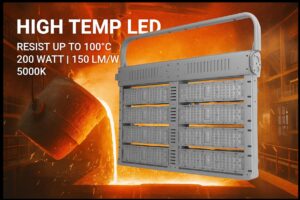
4. Engineering for Extreme Heat
Designing an LED light that can survive 200°C is an engineering challenge that demands innovation in every component.
4.1 Advanced Thermal Dissipation Systems
- Heavy-duty heat sinks made from copper or high-conductivity aluminum alloys.
- Optimized fin geometry for maximum surface area and airflow.
- Passive cooling systems that work without fans (fans tend to fail under high heat).
4.2 High-Temperature Materials
- Housing: Die-cast aluminum with ceramic coating or stainless steel for corrosion resistance.
- Lens: Tempered borosilicate glass or high-temperature-resistant polycarbonate.
- Gaskets and Seals: Silicone or fluorosilicone that maintain elasticity above 200°C.
4.3 Electronics
- Drivers with high-temperature capacitors (aluminum electrolytic or polymer capacitors rated to 150°C+).
- LED chips binned for thermal stability with reduced junction temperature sensitivity.
- Minimal use of plastic components inside the fixture.
4.4 Protective Sealing
- IP66/IP67 sealing against dust and water ingress.
- Protection against molten metal splashes in foundry environments.
5. Performance and Efficiency at High Temperatures
High-temperature-rated LEDs don’t just survive — they perform. A well-engineered fixture can deliver up to 170 lm/W even in elevated ambient heat, rivaling or exceeding standard commercial LEDs used in cooler settings.
Key performance benefits:
- Stable Lumen Output: No rapid depreciation even after 50,000+ hours at rated temperature.
- Color Rendering: CRI 80+ ensures accurate color perception for inspection and quality control.
- Instant-On: Unlike HID lamps, LEDs do not require warm-up periods, critical for operations that cannot afford delays.
- Dimming Capability: Allows energy optimization during non-peak hours without affecting component life.
6. Applications by Temperature Rating
6.1 100°C Rated LEDs
- Foundries and Metal Fabrication – Overhead lighting above casting lines.
- Commercial Bakeries – Continuous oven-side illumination.
- Glass Manufacturing – Around annealing lehrs where temperatures are high but stable.
6.2 150°C Rated LEDs
- Steel Mills – Illumination near ladle furnaces.
- Petrochemical Plants – Lighting around catalytic crackers or distillation columns.
- High-Temp Testing Labs – For automotive or aerospace thermal cycle testing.
6.3 200°C Rated LEDs
7. Dustproof and Environmental Resistance
Heat often comes with another challenge: dust. In cement plants, coal processing, or grain handling, airborne particulates are a constant threat to optical clarity and electrical integrity.
Integrated Protections:
- IP66/IP67/IP68 ratings for dust and water ingress protection.
- Anti-static coatings to reduce dust adhesion on lenses.
- Sealed electronics compartments to prevent dust intrusion into drivers and circuit boards.
8. Installation and Maintenance Considerations
Mounting:
- Heat-resistant brackets and hardware.
- Adjustable angles to keep beam focus despite high-mount installations.
Maintenance:
- Extended service intervals reduce exposure of maintenance staff to hazardous zones.
- Modular designs allow quick driver or LED module replacement.
Remote Driver Installation:
- For extreme heat zones, drivers can be installed up to 30 meters away in cooler areas, connected via high-temp cabling.
9. Economic and Operational Benefits
Longer Lifespan = Lower Cost of Ownership
- LEDs rated for high temperatures typically last 2–4 times longer than conventional lighting in similar conditions.
Reduced Downtime
- Every unscheduled light replacement avoided translates to saved production hours.
Energy Savings
- Up to 60% lower power consumption compared to legacy HID lighting, with immediate payback in energy-intensive facilities.
10. Case Studies & Field Examples
Case 1 – 150°C in Steel Casting Facility
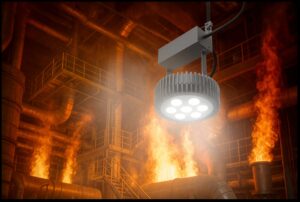
A major steel foundry replaced its high-pressure sodium lights with 150°C-rated LEDs. Result: 55% reduction in power consumption, zero fixture failures over 18 months, and improved worker visibility.
Case 2 – 200°C in Kiln Operations
A ceramics manufacturer installed 200°C-rated fixtures at kiln doors. Even after 24 months of continuous operation, lumen output measured at 92% of initial value.
11. Selecting the Right High-Temperature LED Solution
Checklist for Buyers:
- Confirm ambient and peak temperatures in the intended installation zone.
- Review fixture certifications and test reports.
- Evaluate material specifications (lens, housing, seals).
- Compare lumen maintenance data at rated temperature.
12. Future of High-Temperature LED Lighting
Advancements in ceramic-based PCBs, graphene heat spreaders, and solid-state drivers promise even higher temperature tolerances in the future. Integration with IoT sensors will allow predictive maintenance, adjusting light output automatically based on real-time thermal feedback.
13. Conclusion
High-temperature-rated LEDs aren’t a luxury in demanding industries — they’re a necessity. By offering lighting solutions rated for 100°C, 150°C, and 200°C, manufacturers can provide tailored, reliable illumination for virtually any extreme environment. The result is a safer workplace, lower maintenance costs, and enhanced operational efficiency.
Industries that adopt these solutions now will position themselves ahead of the curve, equipped with lighting that is as resilient as the operations it supports.
–The End–